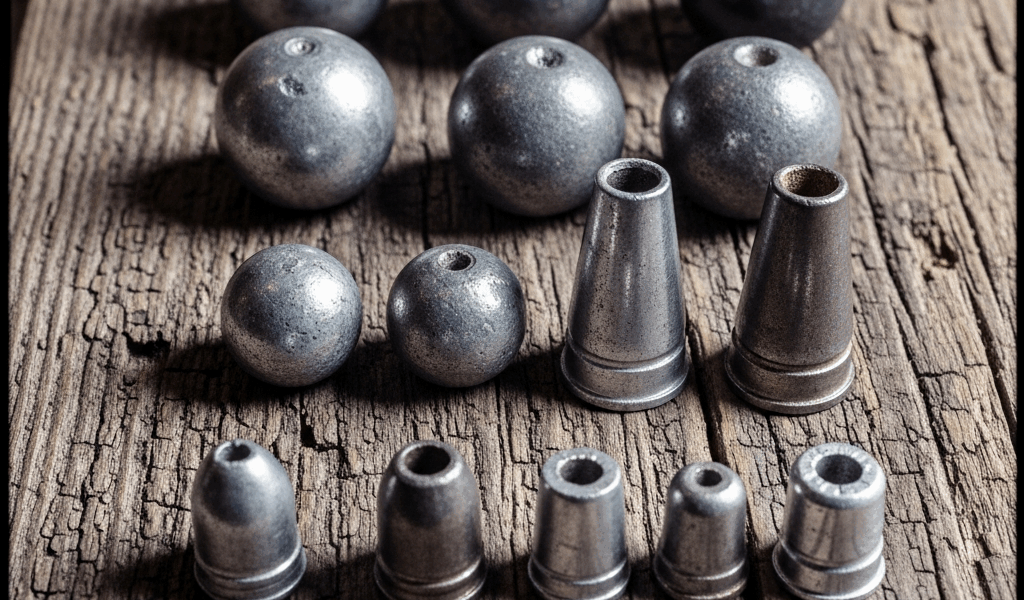
You pulled a misshapen lead slug out of the ground with your metal detector and it weighs about an ounce. The hollow base and three internal rings tell you it is a Minie ball — but which type? Confederate or Union? .58 caliber or .577? And is it worth $5 or $75?
Civil War bullets are the most commonly found relics from the conflict, and identifying them by physical characteristics is straightforward once you know what to measure and where to look. Grab a set of calipers and let us figure out what you have.
The Most Common Civil War Bullets
The Minie ball — correctly called a Minie-type projectile, not actually a ball — is a cylindrical lead bullet with a hollow base that expands on firing to grip the rifling. The hollow base with its internal rings is the defining visual feature.
.58 caliber: the standard US issue. Measure the maximum diameter with calipers. If it reads .575–.585, you have the most common Civil War bullet type. Weight: approximately 500 grains (a bit over an ounce). Three internal base rings are visible on standard-pattern examples.
.577 caliber: British Enfield ammunition, also extremely common in the Civil War. Both Union and Confederate forces used Enfield rifles — the South imported them heavily. The diameter reads marginally smaller than .58, but without precise calipers the difference is difficult to distinguish. A .577 found in a Confederate camp area is likely imported Enfield ammunition.
.54 caliber: earlier pattern from the Harper’s Ferry rifle. Less common than .58 but still found at early-war sites.
The Williams Cleaner bullet: instantly identifiable by a zinc disc embedded in the hollow base. The zinc plug was designed to scrape fouling from the rifle barrel during firing. These are distinctively different from standard Minie balls and command a premium among collectors.
Confederate vs. Union production: Confederate Minie balls are often cruder than Union examples — wider base cavities, visible casting seams from single-mold production, and less uniform shape. The Confederacy lacked mass manufacturing capability, so their ammunition shows more hand-production variation. An irregular cavity with prominent casting seams in a .577 or .58 caliber bullet is likely Confederate origin, which significantly affects collector value.
Cavity-Base Bullet Identification
The number and arrangement of rings inside the base cavity help identify the specific pattern and period of manufacture. Two internal rings indicate an earlier production pattern. Three rings are the standard issue pattern used through most of the war. Variations with notched or segmented bases point to specific manufacturers or experimental patterns.
Confederate production shows more variation in cavity geometry precisely because Southern foundries lacked the standardized tooling of Northern arsenals. If the cavity looks uneven, the rings are not perfectly concentric, or the casting seams are prominent — you are likely looking at a Confederate bullet. Document the cavity details with close-up photographs for identification reference.
Reading the Markings
Most individual bullets do not carry manufacturer stamps. The markings on Civil War ammunition were typically on the cartridge paper wrapper and wooden packing crates, not the projectile itself. However, some cartridge bullets retain partial paper fragments, and some cannon projectiles carry foundry markings.
Pistol bullets are identified primarily by caliber. .44 caliber: Colt Army revolver. .36 caliber: Colt Navy revolver. Measure the maximum diameter with calipers and the caliber tells you the weapon. Revolver bullets are round balls or conical — significantly different in shape from rifle Minie balls.
Artillery projectiles are more likely to carry foundry or lot markings — letters, numbers, or symbols cast into the shell body. These correspond to specific arsenals and production runs. Small canister shot (iron balls) from grapeshot and canister rounds are found at artillery positions and are identified by size and material rather than markings.
Civil War Bullet Values
Values depend on type, condition, whether fired or unfired, and provenance to a named battlefield.
Common .58 caliber Minie ball, fired and dug: $5–20. The market is well supplied — millions were fired during the war and millions have been recovered. Unfired Minie ball with intact cartridge paper: $35–100. Much rarer, and collectors pay a significant premium for unissued ammunition.
Williams Cleaner bullet (dug): $15–40. The distinctive zinc disc makes these visually interesting display pieces. Confederate-identified bullets (identifiable by construction characteristics): $25–75 — a 20–50% premium over equivalent Union examples due to relative scarcity and collector demand.
Artillery projectiles (small, defused): $50–400 depending on type, condition, and identification. Complete cartridge with original paper wrapper: $150–500+. Fired bullets recovered from documented named battlefield sites command significant premiums — but provenance documentation is required for the premium to hold.
Critical note on condition: oxidized lead loses collector value, but cleaning Civil War lead bullets destroys value faster than leaving them dirty. Leave dug bullets as found. Rinse with water to remove loose dirt. Do not wire brush, polish, or treat with chemicals. Collectors want original surface condition.
Metal Detecting and Legal Considerations
Metal detecting on National Park Service land — Gettysburg, Antietam, Manassas, Shiloh, and all other NPS battlefield sites — is federally prohibited under the Archeological Resources Protection Act. Penalties include equipment confiscation and fines up to $100,000 for repeat offenses. There are no permits available for private detecting on NPS land. Do not test this.
Private farmland on or near battlefield corridors: legal with written landowner permission. This is where the majority of Civil War relic recovery happens. State regulations vary — Virginia, Maryland, Pennsylvania, and Tennessee each have specific rules worth reviewing before detecting.
Finding productive sites: period roads, known camp locations (identified from official records and historical maps), and field positions described in after-action reports. Water crossings — fords, bridge sites, and river crossings — are particularly productive because soldiers and equipment dropped items during crossings, and water-recovered items often show less corrosion than ground-dug examples.
River and stream hunting in non-NPS waterways is legal in most jurisdictions and produces some of the best-condition Civil War relics because water-preserved lead corrodes differently than buried lead. Check your state’s specific regulations on underwater artifact recovery before heading out.


Stay in the loop
Get the latest military memorabilia market updates delivered to your inbox.