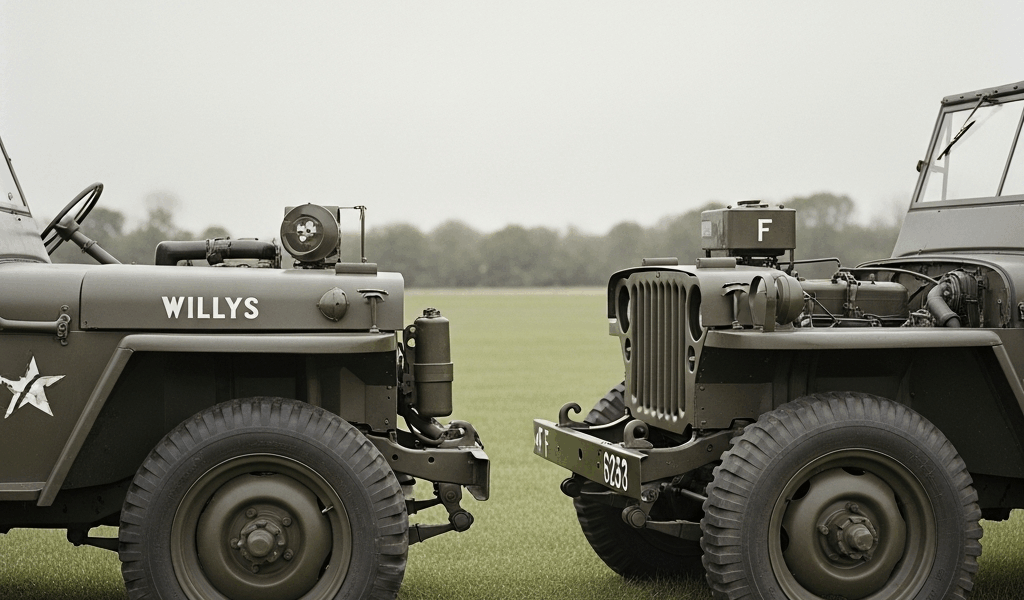
Willys MB vs Ford GPW — How to Tell Your WWII Jeep Apart
Sorting out the Willys MB vs Ford GPW question has gotten complicated with all the bad information flying around swap meets and online forums. As someone who spent the better part of three years completely lost in this hobby, I learned everything there is to know about telling these two vehicles apart — mostly by making expensive mistakes first. I own both now. A ’43 Willys MB that came out of a barn in rural Ohio — dirt still in the wheel wells when I trailered it home — and a ’44 Ford GPW I grabbed at Hershey after a seller dropped his asking price on Sunday afternoon because he was sick of reloading his trailer. Somewhere around $4,200 total between the two of them, and honestly, half that money went toward fixing identification errors I made early on. Accepted a Ford axle on my MB build. Didn’t catch a swapped data plate until a buyer pointed it out. This article is what I wish existed before any of that happened.
This article includes affiliate links. We may earn a commission at no extra cost to you.
Why the Difference Matters to Collectors
Ford wasn’t designing its own jeep. That’s what most people miss when they first stumble into this hobby. The government ran competitive trials in 1941, handed Willys the primary contract, and then basically said — we need more of these than one company can physically produce. Ford came in as a subcontractor. The catch — and it’s a significant one — was that every single component had to be fully interchangeable between manufacturers. A motor pool sergeant somewhere in the Pacific wasn’t supposed to know or care whether the axle housing in front of him came out of Toledo or Dearborn. It just had to fit.
But what is Ordnance Specification G-503? In essence, it’s the government document that locked both manufacturers into producing identical vehicles. But it’s much more than that — it’s also the reason collectors today have such a hard time telling these jeeps apart at a glance. Same 80-inch wheelbase. Same Go Devil four-cylinder. Same transfer case, same axles, same basic body stampings. The spec was not a suggestion.
So why does it matter which one you have? Several reasons that get very real the moment you try to buy, sell, or restore one of these things.
- Originality commands a premium here, and originality means parts from the correct manufacturer — not just correct-looking parts
- Ford components on a Willys aren’t wrong mechanically, but they hit the authenticity value hard
- Misidentified vehicles get sold wrong constantly — sometimes accidentally, sometimes not
- For AACA or MVPA show judging, mixed stampings cost you points and can disqualify a restoration class entry entirely
Ford had to meet the spec, but Ford was still Ford. They stamped their own parts, ran their own foundries, made their own tooling decisions. Those decisions left fingerprints all over the vehicle — if you know where to look.
Frame and Body Differences
Start at the frame. Probably should have opened with this section, honestly, because experienced collectors go straight to the frame when they’re trying to make a quick identification call.
The Ford GPW frame has an F-script stamped into it — a stylized Ford logo pressed into the metal of the frame rails and cross-members. Most reliably found on the front cross-member. Get underneath with a flashlight, passenger side, near where the front axle mounts. On a true unmolested GPW, that F-stamp is there. Willys frames don’t have it. Simple as that.
The body tub is trickier. Both manufacturers used similar stampings overall, but casting differences in the body hardware and small brackets tell you who built what. Most collectors get distracted by the overall shape — don’t. The casting marks on individual small parts are more reliable than eyeballing the general silhouette.
The Rear Body Panel and Tailgate
Ford GPW tailgates have a different reinforcement rib pattern than Willys MB tailgates — visible on the inside face of the gate. The Willys ribbing runs in a slightly different orientation. I spent forty-five minutes at a swap meet arguing with a seller about this exact point before we both pulled out our phones and found the same reference photo. He was right. I was wrong. That’s the kind of thing that happens in this hobby, and it happens to people who think they know what they’re doing.
Small Parts and Stampings — Where Ford Really Showed Its Hand
Ford stamped the letter F on an enormous number of individual components. Steering drag link, axle housing, differential covers, transmission case, brake drums, the engine block itself — the list runs long. Some of these are easy to access. Some require partial disassembly. A thorough identification job on a GPW means checking forty or fifty individual stampings across the whole vehicle. That’s not an afternoon’s work. Plan accordingly.
Willys used different casting marks — MB parts often show a “W” or “MB” designation cast or stamped directly into the part, though the practice wasn’t as systematic as Ford’s F-stamping program. Willys also used slightly different casting methods on items like the transfer case housing. The surface texture is actually visible under close inspection — Ford units tend to have a finer cast surface finish on the NP transferbox components than the Willys equivalents do.
The Grille — One of the More Visible Differences
Early production GPWs had an inverted-U or horseshoe-style opening at the top of the grille, with flat-stamped steel slats. Early Willys MBs ran a slotted grille design that changed during production. By 1943, both manufacturers were building what most people recognize as the standard WWII jeep grille — but early production vehicles show distinct differences that collectors use as dating evidence. Claiming an early-production example? The grille is one of your first verification points. And sellers know this, which means grilles get swapped.
Engine and Drivetrain Markings
Both vehicles ran the Willys Go Devil engine — the Model 441 four-cylinder, 60 horsepower at 4,000 RPM, 105 lb-ft of torque. Same displacement, same bore and stroke, same basic architecture. Ford built their version under license. Here’s how you tell them apart once you’re looking at bare metal.
Block Casting Marks
A Ford-built engine block carries Ford foundry casting marks. Look at the block just below the head on the driver’s side — Ford blocks typically show an F casting mark and often a date code following Ford’s internal dating system. Willys blocks show Willys-Overland casting information, sometimes just the part number, sometimes additional alphanumeric codes depending on when it was built.
The cylinder head is another solid checkpoint. Dimensionally identical between manufacturers — had to be — but the casting marks differ. A Ford head on a Willys block is actually extremely common on vehicles that saw real military service or heavy postwar use, because heads were swapped out constantly during maintenance. Don’t make my mistake of flagging every mixed head-and-block combination as evidence of fraud. It might just mean the jeep had a decent mechanic somewhere around 1951.
Serial Numbers and What They Tell You
Willys MB serial numbers appear on a plate on the left side of the dash and again on the frame. The MB sequence ran from approximately MB 100,001 to MB 361,339 across the full production run. Ford GPW numbers follow a different sequence entirely — GPW 10,001 through roughly GPW 277,896. The prefix tells you everything immediately.
The data plate on the dash is your first stop. Willys reads “Willys-Overland Motors.” Ford reads “Ford Motor Company.” Obvious — except I’ve personally looked at three vehicles at swap meets where that plate had been switched. One was done with period-correct hardware, which suggested whoever swapped it did so a long time ago, probably during an actual repair rather than a deliberate misrepresentation. Probably. You can’t always know.
The vehicle serial number is also stamped into the left front frame horn. That number needs to match the data plate. When it doesn’t, you need a documented explanation — or you have a real problem on your hands.
Value Difference in 2026
Numbers first. A fully restored, numbers-matching Willys MB in excellent condition is moving in the $18,000 to $28,000 range depending on configuration, provenance documentation, and which show circuit the seller is targeting. A comparable Ford GPW — equally restored, equally documented — runs $14,000 to $22,000 in the same market. The Willys premium is real and has held steady for at least a decade now.
That’s what makes the Willys endearing to us collectors — it’s the original. In any vehicle category, collectors pay more for the primary manufacturer over the subcontractor variant, even when the subcontractor version is mechanically identical. Not rational in a strict engineering sense. Completely rational in a collector-market sense. The two things coexist just fine.
Matching Numbers vs Mixed Parts
Frustrated by a restoration stalled over correct Willys-stamped parts, I accepted a Ford axle housing on my MB build because the price was right and I’d run out of patience. Cost me roughly $800 in resale value when I eventually sold the vehicle — a buyer who knew what he was looking at spotted it in about four minutes and negotiated accordingly. The lesson was expensive. At least it was clean.
A mixed-parts vehicle isn’t worthless. These jeeps saw combat, got repaired with whatever was available, spent decades in civilian hands being fixed by people who had no interest in stamp matching. A field-grade vehicle with honest mixed parts and a real history can find a buyer at $8,000 to $12,000. What kills value is misrepresentation — selling mixed as numbers-matching, or claiming a Ford GPW is a Willys MB because someone swapped the data plate forty years ago and nobody caught it since.
What Increases Value Beyond the Baseline
- Documented military unit history — actual paperwork tying the vehicle to a specific outfit, not just a story
- Original paint with visible markings visible beneath restoration layers
- Original accessories still present — jerry can holders, axe brackets, correct pioneer tool configuration
- Early 1942 production date vehicles command additional premiums over later wartime builds
- Verifiable provenance from estates rather than the general swap-meet circuit
The collector community for WWII jeeps is small enough that reputations matter — and large enough that bad information circulates constantly. There are forum threads on G503.com running thousands of replies arguing about whether a specific casting mark variant is correct for a particular production month. That level of obsession is actually useful. It means the knowledge base exists, if you’re willing to dig through it.
Owning both a Willys MB and a Ford GPW has been educational in a way that reading about them never quite managed. You put them side by side in a garage, pull at the same fastener on each one, and the differences stop being theoretical. The F-stamp on the GPW frame rail stops being an abstraction from a forum post and becomes something you’ve actually run your thumb across in the dark. That part no article can replace — but knowing what you’re looking for before you start is worth something. It’s worth, roughly, the $2,100 I spent fixing mistakes I didn’t have to make.

Stay in the loop
Get the latest military memorabilia market updates delivered to your inbox.