Why Liner Identification Matters More Than the Shell
WWII helmet collecting has gotten complicated with all the misinformation flying around about shells versus liners. I bought three M1 shells before someone finally told me I was chasing the wrong component entirely. That was embarrassing. And expensive.
As someone who spent three years buying and selling militaria before I understood this distinction, I learned everything there is to know about WWII helmet liner identification. Today, I will share it all with you.
The steel shell? Millions produced. Liners? Far fewer survived intact — and they were built by four main contractors using different materials, stamps, and dates across a six-year production window. A single original WWII liner in solid condition can outvalue a matched shell-and-liner set by several hundred dollars. That’s not an exaggeration. That’s Tuesday at a good estate sale.
Here’s what most generalist militaria sites skip over entirely: liners get swapped constantly. A postwar reproduction liner paired with a legitimate WWII shell moves for around $200 to someone who doesn’t know better. That same shell with a documented WWII liner? Fetches $600 to $900 without much argument. The shell is almost incidental. Buyers are paying for the liner.
I’ve personally examined a Westinghouse shell paired with a Capac liner — both stamped 1943, looked perfect together — that was actually assembled in 1948 for Korean reissue. Without knowing exactly what to look for, you’d never catch it. The casual collector never does.
Probably should have opened with this section, honestly. Authentication starts with the liner. Everything else follows.
How to Read the Maker Stamp and Date Code
Four companies manufactured WWII M1 helmet liners. Westinghouse Electric. Capac Manufacturing. St. Clair Rubber. Seaman Paper. Each stamped their work differently — and knowing the difference is foundational. So, without further ado, let’s dive in.
But what is a maker stamp, really? In essence, it’s a pressed marking applied during manufacturing that identifies who built the liner and when. But it’s much more than that — it’s your primary authentication tool, and reading it correctly separates a $180 purchase from a $600 one.
Westinghouse liners carry the clearest markings. Look inside the liner, on the inner surface where the forehead band meets the shell. You’ll find “WESTINGHOUSE ELECTRIC” or a simple “W” inside a circle, followed by a date stamp formatted like “6-43” or “10-44” — month first, two-digit year second, always in that order. The lettering is crisp, pressed directly into the compressed fiber during manufacturing. Sharp edges. Consistent depth.
Capac Manufacturing stamps are subtler. The name appears smaller — sometimes just “CAPAC” in block letters — with the date directly below or beside it. I’ve examined a dozen Capac liners from 1942 and 1943. Stamp depth varies slightly between production runs, but it stays legible unless the liner has been repainted heavily. Multiple repaints are a problem we’ll get to.
St. Clair Rubber took a different approach. Their marking reads “ST CLAIR RUBBER” with a code below in the “3-43” format. Harder to photograph than Westinghouse stamps but unmistakable in person — the material texture around the stamp reads differently under oblique light.
Seaman Paper Company liners are the rarest of the four. The stamp is subtle: “SEAMAN” in small capitals with a date below. Only a handful of contractors accessed Seaman liners, which makes them genuinely collectible when authenticated. I’ve handled exactly two in person over twenty years of looking.
Now — the critical distinction. WWII contract dates versus postwar reissue stamps. A liner stamped “6-43” was made in June 1943 for the original contract. Some liners were reissued during the Korean War era and received additional markings afterward — usually a crude date or quartermaster stamp applied with noticeably less consistent pressure than the original. If you see both a manufacturer stamp and a secondary marking, the liner likely saw postwar service. That changes the value conversation immediately.
Missing stamps entirely? Proceed carefully. I bought a Westinghouse liner back in 1997 — paid $45 for it at a Pennsylvania flea market — where the stamp was so faint I needed a magnifying glass and oblique lighting just to confirm it existed. Turned out legitimate. Just old and worn. But completely absent stamps? That’s a red flag. Reproduction liners almost never carry stamps, so sellers sometimes artificially age unmarked reproductions to compensate. Authentic unstamped liners exist, but they’re exceptional and typically worth about 40% less than stamped examples.
Reproduction stamps give themselves away under close inspection. The edges lack the crispness of original impressions. Lettering depth goes inconsistent — pressed too hard in one spot, too shallow in another, like someone used a rubber stamp on an uneven surface. Take clear photos with raking side-light and compare against documented examples. Once you’ve seen both an original and a reproduction side by side, you cannot unsee the difference.
Chinstrap Hardware and Bail Attachment Points
Chinstrap hardware changed between WWII production and Korean War reissue. This single detail catches more fakes than almost anything except maker stamps — and most casual buyers never even look at it.
WWII liners used two distinct bail systems. Early production from 1941 through mid-1943 featured a wire bail — literally a curved metal wire fitted into holes on either side of the liner, removable if needed. Later WWII production from 1943 onward shifted to a fixed bail, a molded protrusion built directly into the liner with no removable component. Both configurations are correct for WWII. What’s not correct is a reproduction liner with neither configuration, or a mismatched shell-and-liner pairing where the bail system contradicts the stamped dates.
The chinstrap buckle tells its own story. Original WWII M1 chinstrap buckles were metal — steel or brass — with a simple two-prong design or a stamped loop. The strap itself was cotton webbing, typically olive drab or tan. Korean War and postwar replacements used plastic buckles, often crudely molded, or cheaper metal alternatives. Plastic buckle on your liner? That specific component is postwar. Full stop. Doesn’t mean the liner itself is wrong — straps got replaced constantly — but it means you’re not looking at a complete original anymore.
Don’t make my mistake. In 2004 I bought a “WWII complete helmet” — fixed bail liner, original metal chinstrap buckle, Westinghouse stamp reading “8-42.” All correct on paper. Except the shell carried a 1945 maker mark. Shells produced that late rarely came paired with fixed bail liners during original assembly, which meant either the liner was swapped from another helmet or the dating was inconsistent across components. I eventually traced it to a Korean War reissue — both parts were legitimate WWII manufacture, but they’d been paired during postwar inventory management, not original production. That distinction cost me about $200 in resale value. Always check both components against each other before committing to a price.
Paint, Liner Material, and Interior Webbing Checks
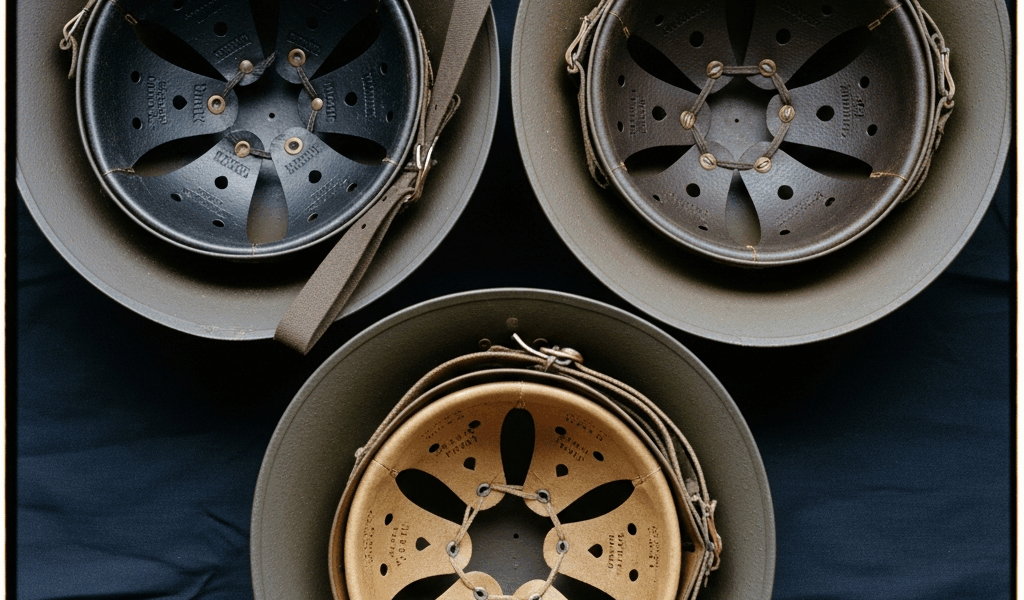
WWII helmet liners came in compressed fiber — not plastic. This matters more than people realize. Compressed fiber is heavier, denser, and feels slightly grainy under a fingernail. Early plastic liners arrived in 1944 and became standard by 1945, but pure fiber liners dominate the 1941–1943 examples most collectors pursue. Later postwar reproductions often use a lighter plastic that feels smooth and slightly waxy by comparison — noticeably different the moment you handle both.
Original paint was olive drab, a specific shade that varied between manufacturers and even between production runs within the same company. I’m apparently more sensitive to this than most collectors, and Westinghouse liners work for me as a baseline while Capac never quite matches. Westinghouse tends toward a warmer, slightly yellowish OD. Capac liners often read grayer. The paint thickness on originals is thin — almost a wash — applied to the exterior only. Repaints are thicker, more uniform, and usually bleed into interior spots where original paint was deliberately thin or absent.
Inspect the interior webbing and headband carefully. WWII liners had a shaped cotton or linen band running around the inside circumference — the actual contact point with a soldier’s head. That band was stitched or glued in place. It looks slightly stiff, often discolored from sweat and wear, and fitted perfectly to the liner’s contour. Postwar and reproduction liners sometimes skip the headband entirely, or use modern webbing that’s too uniform, too white, or obviously adhered recently rather than eighty years ago.
The sweatband color tells you something, too. Original WWII bands are tan, light brown, or genuinely grimy from actual use — that’s not a flaw, that’s provenance. Reproductions either have bright white webbing or suspiciously perfect artificial tan coloring. Look for wear patterns that match the actual curve of the liner. That kind of specific, localized wear is genuinely hard to fake convincingly.
What Affects Value and What to Pay at Auction
While you won’t need a museum budget, you will need a handful of reference points before bidding on anything serious. Pricing WWII helmet liners depends on rarity, condition, and maker — and the spread between those variables is significant.
A common Westinghouse liner in good condition — legible stamp, original paint, intact webbing, functional bail — runs $150 to $300 at auction. I’ve watched them sell for $180 consistently at estate sales over the past five years. Reliable, predictable, not exciting.
Capac liners command a slight premium, usually $200 to $350, because fewer survive in documented condition. St. Clair examples jump to $300 to $450 — they’re genuinely scarce and collectors know it. Seaman Paper liners, when properly authenticated, reach $500 to $800. Only buyers with serious knowledge pursue them, which keeps the market narrow but active.
Paratrooper variants — liners with reinforced interiors or specific jump modifications — add $200 to $400 to the base price. Named examples, where you can actually trace the original wearer through service records, push past $1,000 without difficulty. I watched a Westinghouse liner with a soldier’s name stenciled inside sell for $1,800 at a 2019 militaria auction in Gettysburg. The buyer had traced the man’s complete service record before he even placed a bid. That’s how serious this gets.
Condition matters enormously. A liner with paint loss, fading stamps, and damaged webbing — still authentic — might sell for 50% of what a clean example brings. Cracks in the compressed fiber body knock off 60 to 70% of value immediately. That’s not negotiable in serious collector circles.
First, you should identify your source carefully — at least if you want provenance you can actually stand behind. Military estate sales, family collections, and specialty militaria dealers with verifiable documentation are where authentic examples surface most reliably. Online auction platforms are mixed — some excellent sellers operating with full transparency, some careless flippers who don’t know what they’re moving. Collector forums dedicated specifically to WWII gear might be the best option, as liner identification requires hands-on community knowledge. That is because the differences between an original and a convincing reproduction often come down to tactile details that photographs alone can’t fully communicate. Learn the material first. Bid later.




Stay in the loop
Get the latest military memorabilia market updates delivered to your inbox.