Why WWII Ration Boxes Are Worth Collecting
WWII ration box collecting has gotten complicated with all the misinformation flying around. As someone who spent three years chasing Korean War militaria before stumbling into this corner of the hobby, I learned everything there is to know about paper and cardboard militaria the hard way. Today, I will share it all with you.
The real money — and the real scarcity — sat one shelf over in the WWII section the whole time. Everyone wants medals, insignia, weapons. Nobody thinks about the boxes. Don’t make my mistake.
Here’s the thing. Most WWII ration boxes got torn open in the field, squashed in a duffel bag, or composted into dust during seventy-five years of basement storage. Finding an intact or near-intact example is genuinely rare. The ones that survived are now hitting collector markets with serious price appreciation — especially as Korean War stock gets correctly identified and filtered out.
A consolidated WWII ration box identification guide for actual collectors basically doesn’t exist. You’ll find survivalist sites obsessing over MRE comparisons. You’ll find historians cataloguing contents. But people buying and selling authenticated paper ephemera need to know one thing: how to tell a 1943 C-ration box from a 1951 reissue, and what that difference means for your wallet. So, without further ado, let’s dive in.
The Main Types of WWII Ration Boxes Collectors Find
Three box types dominate WWII-era ration collecting: C-ration, K-ration, and 10-in-1 ration boxes. But what are these, exactly? In essence, they’re military-issue cardboard food containers produced under wartime contracts. But they’re much more than that — each has distinct physical characteristics that matter enormously for identification and valuation.
C-Ration Boxes
C-rations came in individual cardboard boxes, roughly 6 inches by 3.75 inches by 2.5 inches. Brown or tan ink on kraft cardboard. The label “Meal, Combat, Individual” ran horizontally across the front in stenciled text, with contents — meat components, biscuits, candy, cigarettes, accessories — identified on the face. The military produced these in the billions, which is why they’re the most frequently encountered type in collector markets today. Common doesn’t mean worthless, though. Condition is everything here.
K-Ration Boxes
Probably should have opened with this section, honestly, because K-rations are visually the most distinctive and the easiest to identify correctly. They targeted paratroopers and specialized units. Noticeably smaller than C-rations — about 5 inches by 3 inches by 2 inches. The printing quality was crisper, and red, blue, or green striping denoted meal type: breakfast, dinner, supper. Rarer than C-rations. Commands higher collector interest. I’m apparently a K-ration person and Heritage Auctions works for me while eBay listings never quite match up on authentication.
10-in-1 Ration Boxes
Unit-level rations, meant to feed ten soldiers for one day. Significantly larger — roughly 11 inches by 8 inches by 6 inches. Bolder printing, detailed component lists. You’ll rarely find a 10-in-1 box intact because they were meant to be broken down and distributed immediately after delivery. Fragment examples sell regularly, but complete specimens are investment-grade items. Full stop.
D-ration wrappers — the chocolate bars — also circulate among collectors, though technically not boxes. Mint examples with period-correct wrappers fetch $40 to $150 depending on rarity and the specific chocolate formulation stamped on the wrapper. That’s what makes D-ration wrappers endearing to us paper ephemera collectors — they’re small, affordable, and nobody fights you for them at shows.
How to Read the Date Codes and Manufacturer Stamps
This is where authentication actually happens. A supplier unfamiliar with coding systems will wildly misprice identical boxes. You need to know what you’re looking at before you hand over cash.
Date Stenciling
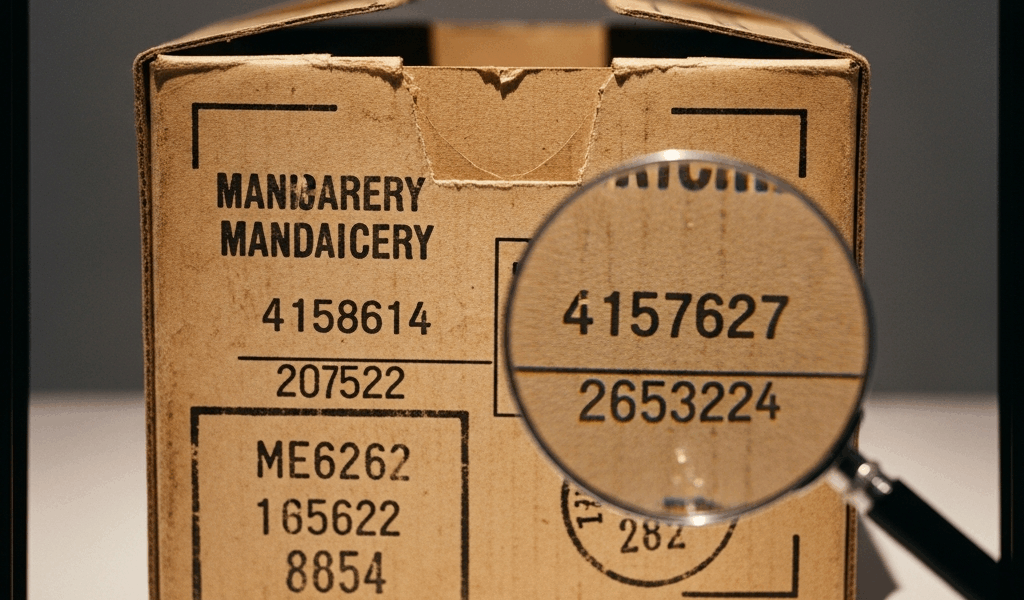
Dates appear in stenciled format on C-ration and K-ration boxes — usually on the left or bottom edge. The format was month/year. You might see “6-43” for June 1943 or “12-44” for December 1944. The stencil ink varies from sharp and clean on fresh stock to faded and bleeding on aged or poorly stored examples. Earlier dates command premiums. A 1942-dated box is worth roughly triple a comparable 1945 example. Most boxes you’ll encounter were produced between 1944 and 1945, when production ramped hard to supply the European and Pacific pushes.
Lot Codes and Contractor Abbreviations
Manufacturer abbreviations appear as stenciled codes, usually two or three letters: “WD” for War Department, “QMC” for Quartermaster Corps, “W” for Wrigley — they supplied gum components. These aren’t reproduction markers. They’re authentication markers. A legitimate WWII C-ration box should carry at least one recognizable contractor code. No codes at all? Or codes referencing manufacturers that didn’t exist until 1952? You’re looking at a reproduction or Korean War reissue. Walk away.
Lot numbers appeared in small print, often bottom right corner. They identify the specific production run. Matching lot numbers across multiple boxes suggests they came from the same field kit — a detail collectors obsess over, and reasonably so. Complete matched sets appreciate faster than singles.
Inspection Stamps
Frustrated by the prevalence of convincing fakes, experienced collectors developed a simple authentication habit using nothing more than a loupe and decent lighting. The inspection stamp — a rubber impression from QMC inspectors certifying a sealed box met standards — reads “INSPECTED BY” followed by initials or an inspector number. Real stamps are slightly smudged. Occasionally skewed. The ink color varies because different inspectors used different stamp pads. Reproduction stamps look too uniform, or they’re positioned oddly. That visual consistency is actually the giveaway.
Korean War Reproductions and Post-War Stock — What to Watch For
The single largest mistake I see in this hobby is dealers confidently selling 1951 Korean War C-ration boxes as 1943 WWII stock. The boxes look almost identical to untrained eyes. Here’s what separates them.
Font weight changed between WWII and Korean War production. WWII printing used consistent, crisp serif fonts. Korean War boxes switched to slightly heavier sans-serif printing — most visible on the component labels. Squint at the “Meal, Combat, Individual” header. If it looks bolder or more modern than you’d expect, it’s probably post-war.
Contractor lists expanded significantly after 1945. WWII boxes list four to six manufacturers. Korean War boxes list eight to twelve because production was distributed across more plants. Count the contractor codes. More than seven? Assume 1950 or later.
Box board texture shifted too. WWII cardboard was rougher, slightly yellowed kraft. Korean War production used smoother, whiter stock. Flip the box over and examine the unprinted side. WWII boards feel gritty. Post-war boards feel almost slick. That tactile difference takes about thirty seconds to learn and saves you hundreds.
Date stencils on Korean War boxes sometimes include full dates — month, day, year — rather than just month and year. A box reading “6-15-51” is definitively post-war. That was 1951. No debate.
Condition Grading and What WWII Ration Boxes Sell For
Condition determines value — sometimes dramatically. While you won’t need a professional conservation lab, you will need a handful of reliable reference points when pricing or assessing a purchase. Here’s the grading scale that matters in practice.
Intact Sealed
Original seals unbroken, all edges and corners intact, printing clearly legible. These are rare enough to list individually. Expect $120 to $300 for common C-rations, $250 to $500 for K-rations, $400 and up for 10-in-1 examples. A sealed K-ration with matched dating across all components can sell for $800 to $1,200 — at least if the documentation supports it.
Intact Empty
Box structure sound, no major tears or crushing, seal broken and contents removed. $50 to $150 for C-rations, $120 to $300 for K-rations, $200 to $400 for 10-in-1 boxes. This might be the best option for new collectors, as ration box collecting requires patience and budget discipline. That is because intact empty examples stabilize in price while still offering excellent display value. This is where most collectors hunt first.
Partial
Significant wear, visible creasing, minor tears — but the box is recognizable and dating is legible. $20 to $60 for C-rations, $40 to $120 for K-rations. Partial examples work well for themed collection backgrounds or military diorama displays. First, you should consider these as entry points — at least if you’re building themed displays rather than investment-grade collections.
Fragment
Pieces of original box with visible printing and legible dating. $5 to $25. Collectors buy fragments to verify production runs or fill specific date gaps in documentation. Unglamorous. Genuinely useful.
Complete matched unit sets — say, a full 10-in-1 ration still containing three or four sealed C-ration subcomponents in original packaging — multiply values by 2.5 to 4 times the individual box price. A $300 10-in-1 box becomes a $750 to $1,200 find if three original C-rations are still nested inside. That’s what makes complete sets endearing to us serious collectors — the math changes fast, and most sellers don’t realize it until after the sale.



Stay in the loop
Get the latest military memorabilia market updates delivered to your inbox.