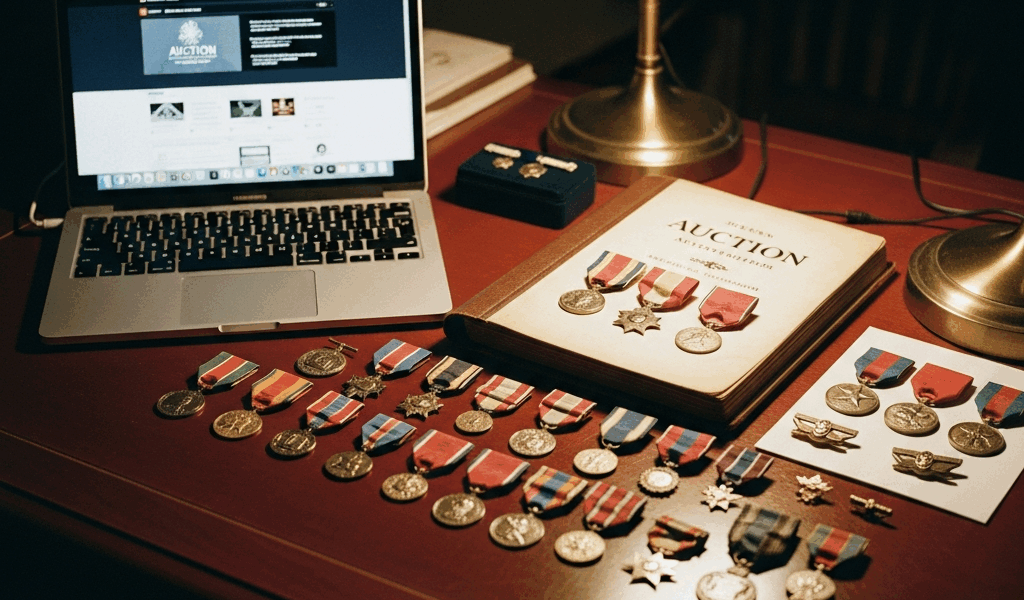
The Top 5 Online Militaria Auction Platforms
Militaria collecting has gotten complicated with all the fake listings, overpriced reproductions, and sketchy sellers flying around. As someone who has bought and sold across five different platforms over the past eight years, I learned everything there is to know about where serious collectors actually spend their money. Today, I will share it all with you.
Short answer to “which platform is best”: there isn’t one. It depends entirely on what you’re hunting for — and whether you’re buying or selling.
IMA-USA
IMA-USA dominates high-end American militaria. Weekly auctions. Authentication standards that are genuinely rigorous — not marketing-copy rigorous, actually rigorous. I’ve purchased three items from them personally: a complete WWI uniform grouping with correct insignia, a set of 1918-dated mess kits, and a captain’s saber from the Spanish-American War era. All three were exactly what they claimed.
The buyer’s premium runs 20%. That stings. But you’re paying for their reputation and their willingness to guarantee authenticity in writing — which most houses won’t do.
Their catalog descriptions are obsessive in the best way. They measure everything. Multiple angles on every photograph. Maker’s marks identified. Manufacturing variations noted. If you’re new to collecting, honestly, just reading their lot descriptions teaches you more than most books will. Terminology, historical context, condition grading — it’s all there for free.
The downside: selection skews heavily toward U.S. material. European items appear occasionally but aren’t their strength. Shipping runs slow, and that 20% premium is steep compared to other houses.
Rock Island Auction
Rock Island covers a broader spectrum than any other house on this list. Firearms, edged weapons, uniforms, insignia, accessories — all in the same sale. Their buyer’s premium sits at 15%, lowest I’ve seen among specialty houses. They authenticate firearms aggressively because of liability reasons. Uniforms and insignia get less scrutiny, which means you need to know what you’re looking at before you bid.
Two years ago I bought a Prussian officer’s saber from them — paid significantly less than I would have at Hermann Historica. Blade was authentic. Hilt fittings were correct. The leather grip wrap had been replaced, which their description did mention, just quietly. Still a solid buy at the price. But I should have asked for closer photos of the wear patterns before bidding. Don’t make my mistake.
Their live auction streaming is excellent. You can watch in real time, phone bidders compete openly alongside internet bidders, and the whole thing feels transparent. That’s what makes Rock Island endearing to us collectors who hate surprises.
Hermann Historica
But what is Hermann Historica, really? In essence, it’s a Munich-based auction house. But it’s much more than that — it’s the gold standard for European militaria, full stop. Their specialization in German, Austrian, and Eastern European material is unmatched anywhere. Western European items get thorough coverage too. The buyer’s premium is 25%, highest of the five platforms I’m discussing here, but you’re working with the most conservative authenticators in the business.
I’ve had exactly one regret with them. I overbid on a Wehrmacht officer’s tunic that I later realized had been heavily altered. Here’s the thing — their pre-sale estimate was honest about the condition issues. I bought with emotion instead of patience. That was my fault entirely, not theirs.
Shipping to the U.S. runs 10-14 days typically. Currency conversion adds a small layer of unpredictability — budget for it. Their prices are often surprisingly reasonable because European collectors have genuinely different spending patterns than American buyers. That gap works in your favor if you know where to look.
Warpath Militaria
Warpath is newer, smaller, and scrappier than the others. They focus specifically on Native American military service items, Indian Wars material, and frontier-era artifacts. Buyer’s premium is 18%. They don’t carry the institutional weight of IMA-USA or Hermann Historica — nobody pretends otherwise.
For their niche, though, they’re thorough. Their auctions run 14 days rather than the standard 10, which gives you time to actually research and send condition questions without panicking. I’ve purchased twice from them, both times on items I initially passed on and came back to after sitting with them for a week. That slow auction pace is what enabled that — it’s a feature, not a bug.
The risk worth naming: their authentication standards are solid but less extensive than IMA-USA’s. They stand behind their material. But you’re depending on a smaller team with less market visibility. That’s the trade-off.
eBay
eBay deserves its own section because it operates completely differently from the specialty houses — but it belongs on this list because enormous amounts of militaria move through their platform every single day. Buyer’s fees run 12.9% plus $0.30 per transaction. For sellers, final value fees are also 12.9%. It’s a marketplace, not an authenticated auction house. That’s both its strength and its fatal weakness. So, without further ado, let’s dive in.
eBay for Militaria — When It Works and When It Does Not
Probably should have opened with this section, honestly. Understanding eBay’s limitations is critical before you spend money there — and I mean real money, not $15-cap-badge money.
I’ve found incredible deals on eBay. I’ve also received counterfeit medals, reproductions misrepresented as originals, and items with condition issues that photos somehow managed to conceal entirely. The platform’s buyer protection is real but not foolproof. If an item arrives exactly matching its listing description, eBay will defend the seller — even if that description was technically deceptive by omission.
Filtering for Reputable Sellers
Start with feedback. Look for 98% or higher ratings with thousands of transactions. Read the negative feedback specifically — that’s where the truth lives. A seller with 50 total transactions and 100% feedback is less trustworthy than a seller with 5,000 transactions and 98% feedback. Volume matters more than perfection. Always.
Second: look at their other listings. If someone sells militaria daily, they understand the category. If they’re running a general goods store and occasionally post military items between kitchen appliances and vintage toys, they might genuinely not know what they’re selling. I’m apparently too trusting — I bought a Wehrmacht dagger from someone listing three pieces of militaria alongside 200 other product categories. The dagger was incorrect. Blade geometry was wrong. The crossguard didn’t match the scabbard style. This should have been obvious to anyone with category knowledge, including me.
Third: ask questions before bidding. Reputable sellers respond quickly and provide additional photos without complaint. I once asked a seller to photograph the maker’s mark inside a helmet — they sent six additional detailed shots within two hours. I bid confidently. Item arrived exactly as described. Compare that to sellers who respond with vague dismissals. Move on. There are thousands of other listings.
Authentication Risk and Reality
eBay doesn’t authenticate militaria the way specialty houses do. The platform runs on seller honesty and buyer knowledge. Reproduction pieces slip through regularly. I’ve seen 1950s-manufactured reproductions listed as original 1930s items. Painted reproductions sold as hand-aged patina. Uniform alterations buried in unclear photos.
The buyer protection works if an item arrives “not as described.” But “described” is the loophole. If a seller photographs a Wehrmacht tunic, claims it’s from the 1940s, and doesn’t mention a recent collar replacement — and you receive a tunic with a recent collar replacement — eBay may side with the seller. Because the tunic is objectively what was photographed. The rules are written that way.
When eBay Actually Works
eBay excels for common items with objective, measurable specifications. Medals are the perfect example. A German Imperial Iron Cross First Class has specific dimensions, specific manufacturing details, specific hook mechanisms, specific ribbon specs. If you know what to look for, you can verify authenticity from photographs. Reproductions show different weight appearances in photos, different hook styles, different ribbon weave patterns.
I’ve purchased thirty medals on eBay. Kept twenty-eight. The two I returned were items I mislabeled in my own research — not seller fraud. That specificity works for eBay because authentication reduces to checklist verification.
Uniforms are the opposite situation. Condition variation is enormous. Alterations are common. Dyes fade differently by lot and storage conditions. Sizing conventions changed over decades. Without physical inspection, you’re guessing. I’ve bought uniforms on eBay successfully only when sellers provided measurements at three specific points — shoulder width, sleeve length, chest circumference — plus an honest assessment of stains, repairs, and wear. Anything less than that, I pass.
Specialty Auction Houses vs General Platforms
The fundamental difference: specialty houses employ experts who handle items the way archaeologists handle artifacts. General platforms like eBay run on seller honesty and buyer knowledge. One of those systems scales. The other one is fragile.
Specialty house pricing reflects their expertise. A German officer’s tunic authenticated by Hermann Historica sells for 40-60% more than an identical tunic on eBay — because the Hermann Historica attribution carries institutional weight. Museums cite specialty house attributions. They ignore eBay listings entirely.
But if you’re buying for personal enjoyment and you understand the category deeply, eBay’s lower prices represent real savings. I spent $850 on a Wehrmacht greatcoat from Rock Island. An identical greatcoat with identical provenance documentation would have fetched $1,400 from Hermann Historica. Same item. Same condition. Different platform, different market.
When Specialty Houses Make Financial Sense
Buy from specialty houses when the item is expensive, rare, or requires authentication you can’t personally perform. A $3,000 sword purchase demands professional authentication. A $15 cap badge does not. That’s the line.
Buy from specialty houses when purchasing for institutions or significant collections. The documentation creates permanent value — provenance that survives you and your collection. Museums care about this deeply. Collectors who eventually sell to museums care about specialty house documentation for exactly that reason.
Buy from specialty houses for unique items. Battlefield-excavated artifacts need professional examination. Items with unusual maker’s marks or manufacturing variations need expert eyes on them in person.
When General Platforms Make Sense
Buy from eBay when you’re building a learning collection, when you understand the category, when the item is common enough that a mistake is recoverable, and when you’re willing to accept authentication risk in exchange for price advantage. Those conditions matter — all of them, not just one or two.
I maintain two separate collections: specialty house purchases I plan to keep permanently or eventually sell to institutions, and eBay and general marketplace purchases I actively rotate. The rotating collection teaches me. The specialty collection represents my serious scholarship. That separation has kept me sane and solvent for eight years.
Selling Tips — Where to Get the Best Price
Selling is where platform choice becomes genuinely consequential. I’ve consigned items to specialty houses and listed directly on eBay, and the financial outcomes differ dramatically enough to warrant serious thought before you decide.
Consignment versus Direct Listing
Consignment to a specialty house works like this: you ship the item to them, they photograph it, write the description, authenticate it, run the auction, and send you net proceeds after their commission. Commissions vary — IMA-USA charges 25% for items over $500 and 20% for items under that threshold. Rock Island runs 15%. Hermann Historica runs 30%.
You pay nothing upfront. You assume zero marketing risk. The auction house’s reputation backs your item. You receive professional photography and description writing that maximizes perceived value without you lifting a camera.
The downside: you lose control. You can’t adjust reserve prices mid-sale. You can’t answer bidder questions directly. You receive net proceeds after commission, which substantially reduces what hits your account.
I consigned a Prussian officer’s uniform grouping to IMA-USA — complete, correct insignia, excellent condition throughout. They estimated $800-1,200. It sold for $2,100. After their 25% commission, I received $1,575. Would I have gotten anywhere near that listing it myself on eBay? No. Not even close. The commission was expensive. It was also justified.
Direct listing works differently. You write the description, photograph everything, answer questions, handle payment, pack it, ship it, and keep proceeds minus platform fees. You control everything — reserve prices, auction timing, early termination if you get an acceptable offer. You also do all the work. Both things are true simultaneously.
Photography and Description Strategy
This is where amateurs leave thousands of dollars sitting on the table. Bad photos reduce final prices dramatically — not slightly, dramatically. A Wehrmacht tunic photographed on a wire hanger against a white wall sells for 20-30% less than the same tunic photographed on a mannequin with proper lighting showing detail stitching, maker’s marks, and wear patterns.
I learned this expensively. My first tunic listing used four photos taken on my kitchen table under overhead fluorescent light. It sold for $320. The next tunic — identical condition, similar rarity — I photographed carefully with twelve images: full front, full back, shoulder details, collar details, cuff details, interior labels, size measurements laid flat against a ruler, and wear areas in close-up. It sold for $485. Same category of item. Different presentation. $165 difference. That’s the lesson.
Descriptions need specificity that hurts to write but pays off. Instead of “WWI German uniform,” write: “Imperial German Army enlisted man’s tunic, Fourth Army Corps, c. 1916-1918, field gray wool, correct brass buttons with visible stamping, interior label present, size approximately 42 chest, collar shows moderate wear consistent with field use.” Measurements matter. Material composition matters. Historical context matters. Wear patterns matter — and honest disclosure of them builds bidder confidence rather than destroying it.
List the item on the platform where your actual target buyer shops. Uniforms and insignia attract different buyers than edged weapons. German material attracts different collectors than American material. Hermann Historica reaches international buyers willing to pay premium prices. eBay reaches budget-conscious domestic buyers. Knowing that distinction before you list saves you real money.
I now maintain a simple rule: items estimated under $400, I list directly. Items estimated over $800, I consign. Items between $400 and $800, I evaluate case by case based on category and rarity. That framework has held up for years without me second-guessing it constantly.
The best online militaria auction platforms aren’t universally “best” — they’re best for specific purposes. Build your buying strategy around what you’re collecting, your expertise level, and your patience for authentication research. Build your selling strategy around what the item is worth and what price tier it occupies. The collectors who consistently maximize value across multiple platforms are the ones who understand each platform’s actual strengths — not the ones hunting for a single perfect answer that doesn’t exist.


Stay in the loop
Get the latest military memorabilia market updates delivered to your inbox.