Why Korean War Insignia Gets Confused With WWII
Korean War insignia has gotten complicated with all the WWII confusion flying around. I spent three years building a collection before realizing I’d authenticated two sergeant chevrons completely wrong — both of them. The first one I’d grabbed at a flea market for $8 came with a seller’s guarantee it was “WWII era.” The second sat in my drawer for months before I actually compared backing materials under decent lighting.
As someone who collects military rank insignia, I learned everything there is to know about why this happens. Most collectors skip right past Korean War pieces. They hunt WWII medals, dress uniforms, Pacific theater memorabilia instead. Korean War items get treated like the overlooked middle child. Guides everywhere focus on 1941-1945 ranks, leaving 1950-1953 virtually uncovered. This creates a massive gap where buyers and sellers operate on assumption instead of knowledge. Today, I will share it all with you.
The timeline overlap makes everything worse. Production standards didn’t reset in 1950. Manufacturers kept using similar patterns, fabrics, construction methods from the previous decade. A U.S. Army sergeant chevron from December 1945 looks almost identical to one from March 1951 to an untrained eye. The uniform styles themselves remained largely unchanged — Ike jackets stayed in use, wool serge continued as the standard fabric, even backing materials transitioned slowly rather than flipping overnight.
What actually changed — and this matters for valuation — was manufacturing volume and quality control. Early Korean War production (1950-51) often shows inconsistent stitching, variable dye lots, and backing variations. Late war pieces (1952-53) become more standardized as manufacturers ramped up. A rare rank from 1950-51 with poor production consistency might fetch $45-65. That same rank from 1952-53 with clean manufacturing could hit $20-35 because supply increased. This progression directly impacts price.
I made my authentication mistake because I trusted seller narrative instead of examining the piece itself. The backing told the real story — wool felt versus cotton sateen showed me I had one WWII piece and one Korean War piece. That’s the mistake I see repeated constantly in online auctions.
How to Read US Army Rank Insignia From Korea
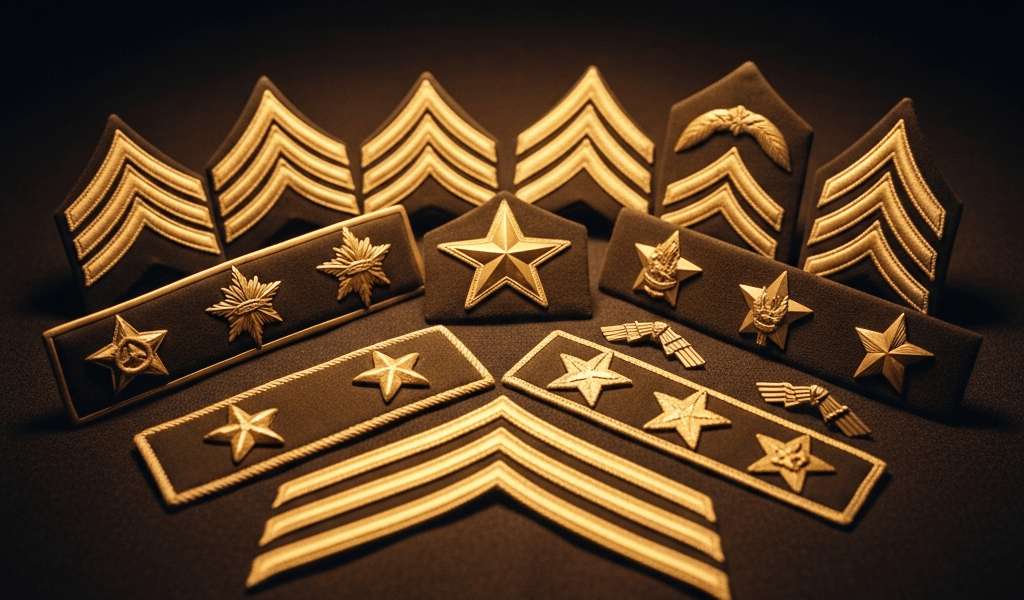
Start with the basic structure. Enlisted ranks used chevrons — those V-shaped stripes pointing upward. Officers wore insignia on shoulder boards or collar tabs depending on service branch. This distinction alone eliminates half your identification challenges.
For enlisted chevrons specifically, count the stripes. One upward stripe equals private first class. Two stripes make a corporal. Three stripes get you to sergeant. Four stripes with a rocker (curved stripe beneath) means staff sergeant. The complexity increases from there, but those four rank categories account for roughly 70% of what you’ll encounter in Korean War collections.
Now examine the material construction — this is where things split apart between eras. WWII-era chevrons predominantly used wool felt backing with wool or cotton embroidered chevrons. Korean War pieces show more variation. Early 1950 production mixed wool with synthetic materials as shortages and cost pressures hit. By 1952-53, you see more pure synthetic backing appearing, especially on stateside uniforms versus field-issue items.
The chevron itself — the colored stripe — changed in material composition. The earliest Korean War pieces (1950-51) used embroidered wool thread, typically in olive drab, yellow, or green depending on branch. As the war continued, manufacturers switched to machine-woven chevrons on backing material, reducing labor costs. This shift alone dates your piece within 18-month windows.
Check the backing. Flip the insignia over — honestly, this step matters more than collectors realize. WWII-era backing feels heavier, more rigid, usually wool felt in tan or khaki. Korean War backing, especially post-1951, becomes lighter, sometimes plastic-coated cotton, occasionally even thin rayon. Run your thumb across it. The texture difference is unmistakable once you’ve handled five or six examples.
Stitching patterns reveal manufacturing standards. Early Korean War chevrons show hand-stitching around edges, sometimes loose, sometimes tight but inconsistent. Edges might fray slightly. Late war examples display machine-stitched edges with consistent tension and occasional overstitching for durability. This detail matters because it separates rushed 1950-51 production from standardized 1952-53 output.
Officer ranks get trickier — you won’t need extreme expertise, but you will need a handful of reference materials and some patience. Captain bars remained similar across both wars (two gold bars on insignia boards). First lieutenants kept one gold bar. Second lieutenants got one silver bar. The backing board itself changed, though. WWII officer boards used thicker, heavier cotton twill. Korean War boards lightened up, sometimes showing visible weave texture rather than dense cloth.
Key Identifying Features That Prove Authenticity
Thread color variation separates authentic from reproduction pieces more reliably than most collectors realize. During the Korean War, thread dye batches weren’t standardized like later decades. One sergeant chevron might show olive drab thread that’s nearly brown. Another from the same manufacturing run could appear distinctly green. Counterfeits rarely capture this variation because modern dyes produce uniform color.
Examine thread thickness under magnification — at least if you want to spot fakes immediately. Authentic Korean War enlisted insignia used relatively heavy thread, roughly equivalent to modern 6-strand embroidery floss. Cheap counterfeits skip this detail, opting for thinner thread that produces a flatter appearance. Legitimate pieces show actual texture and dimension when you look at them side-by-side with fakes.
Backing material composition tells you everything about authenticity once you know what to seek. Genuine Korean War insignia backing shows these characteristics: wool felt backing crumbles slightly when you press it after 70 years; synthetic backing from 1951-52 feels waxy or plastic-coated when rubbed; cotton sateen backing shows visible weave pattern. Counterfeits almost always use modern synthetic backing that feels too uniform, too fresh, too perfect.
Stitching pattern authenticity gets overlooked constantly. Probably should have opened with this section, honestly. Machine stitching on authentic Korean War pieces shows needle marks at consistent intervals — roughly 2-3mm apart depending on military spec. Hand stitching appears irregular but even-tensioned. Counterfeits often mix both types randomly or show digital embroidery with computer-perfect regularity that looks nothing like 1950s manufacturing.
Look for manufacturing marks on the backing. Some Korean War insignia carries faint stampings, usually manufacturer initials or contract numbers. These appear inconsistently, which is actually the point. Their absence doesn’t prove inauthenticity, but their presence strongly indicates genuine military issue. Counterfeits rarely include this detail because sellers don’t know to look for it.
One common counterfeited mistake jumps out immediately: incorrect thread-to-backing adhesion. Authentic Korean War pieces show thread penetrating the backing substantially, sometimes visible on the reverse side. Cheap counterfeits glue thread to the surface, creating a papery feel when flexed. Bend a corner gently — authentic pieces flex and recover. Counterfeits show cracking or separation.
Color fading patterns authenticate genuinely aged pieces. Authentic Korean War insignia shows uneven fading based on storage conditions and wear patterns. One edge might fade slightly more than another. Counterfeits fake uniform fading that looks too consistent. Real aging creates irregular patterns.
Korean War Insignia Values by Branch and Rank
Supply and demand drive Korean War insignia pricing more dramatically than WWII pieces because fewer exist and fewer collectors chase them. That’s what makes this period endearing to serious collectors — scarcity creates real opportunity.
| Rank/Type | Branch Premium | Common Price Range | Rarity Factor |
|---|---|---|---|
| Private First Class chevron | Army standard | $8-15 | Very Common |
| Corporal chevron | +5% for Marine Corps | $12-22 | Common |
| Sergeant chevron | +15% Air Force | $18-35 | Moderately Common |
| Staff Sergeant chevron | +20% for 1950-51 dating | $35-65 | Uncommon |
| Officer bars (Captain) | +30% for documented provenance | $45-85 | Rare |
| Specialist ranks | +50% (Medical, Signal Corps) | $55-120 | Very Rare |
Condition impacts pricing heavily. A staff sergeant chevron in excellent condition with minimal wear commands $55-65. The same rank with fraying, faded colors, or backing deterioration drops to $35-45. This matters more in Korean War collecting than WWII because fewer examples survive in premium condition.
Branch creates meaningful premiums. Marine Corps insignia consistently runs 10-20% higher than Army equivalents. Air Force ranks command a slight premium, roughly 5-8% for comparable pieces. Navy insignia remains least collected, so prices actually run lower despite equal rarity.
Real-world example: I bought an authenticated Marine Corps sergeant chevron from 1951 with excellent condition backing for $42 at a show. Seller had documentation showing it came from a family collection. Two weeks later, an identical Army sergeant without provenance sold on eBay for $28. The difference? Authentication and documented history. That same rank in fair condition (visible wear, slight backing deterioration) consistently sells for $15-20.
Documented provenance multiplies value substantially. A captain’s rank insignia with unit attribution and service record can fetch $120-180. The same rank with zero documentation might only reach $55-75. This is where Korean War collecting differs from WWII saturation — documentation becomes the differentiator.
Where Collectors Go Wrong When Buying
Storage damage creates the biggest destroyer of Korean War insignia value. Moisture exposure causes backing material to swell and thread to mildew. Acid from poor storage materials literally eats dyes. I’ve seen beautiful sergeant chevrons ruined by storage in plastic bags without acid-free tissue. The backing develops brittleness. Colors fade unevenly. Don’t make my mistake.
Improper cleaning causes irreversible damage. Water exposure can strip dyes and cause backing materials to separate. Dry cleaning solvents sometimes dissolve the synthetic backings used in 1951-52 pieces. Collectors trying to “restore” insignia often destroy authenticity and value simultaneously. If your piece is soiled, leave it alone unless you have professional textile conservation experience.
Mixed-era groupings confuse chronology. Buying a uniform grouping with insignia from 1948-1954 looks like getting variety. It actually creates authentication nightmares. You can’t date individual pieces accurately when they’re mixed. This compounds when you’re trying to verify whether you own Korean War pieces or late-WWII pieces with similar characteristics.
Seller claims without documentation kill deals constantly. “Military family estate” means almost nothing without specific unit information, dates, or service records. “Guaranteed Korean War” from an eBay seller with 47% positive feedback means less than zero. Demand documentation. Ask for photographs of backing, thread, and stitching patterns before purchasing. Legitimate sellers provide this willingly.
Auction site guesses replace actual authentication. eBay sellers listing items as “WWII or Korean War era” essentially admit they don’t know. Don’t buy uncertainty. Wait for dealers who’ve done the research. Sites focused on Korean War memorabilia specifically, rather than general WWII estate liquidators, provide better accuracy because specialists develop expertise through repetition.
Condition expectations destroy value perception. A Korean War insignia will show age. Backing might show slight discoloration. Thread might show minor wear. This is normality, not damage. Expecting 75-year-old military issue to look like fresh manufacture means you’ll overpay for modern counterfeits or disappoint yourself constantly with authentic pieces.
The safest approach: Buy from dealers specializing in Korean War items specifically. Compare multiple examples before purchasing. Examine backing, thread, and stitching under magnification. Request detailed photographs. Build knowledge before building collection. Korean War insignia remains undervalued precisely because most collectors skip the authentication work. That gap creates opportunity for informed buyers who actually know what they’re holding. So, without further ado, dive in.
Period insignia research should not be transferred onto modern uniforms. Our Army Pinks and Greens collector guide separates current AGSU terminology from historical claims.

Stay in the loop
Get the latest military memorabilia market updates delivered to your inbox.