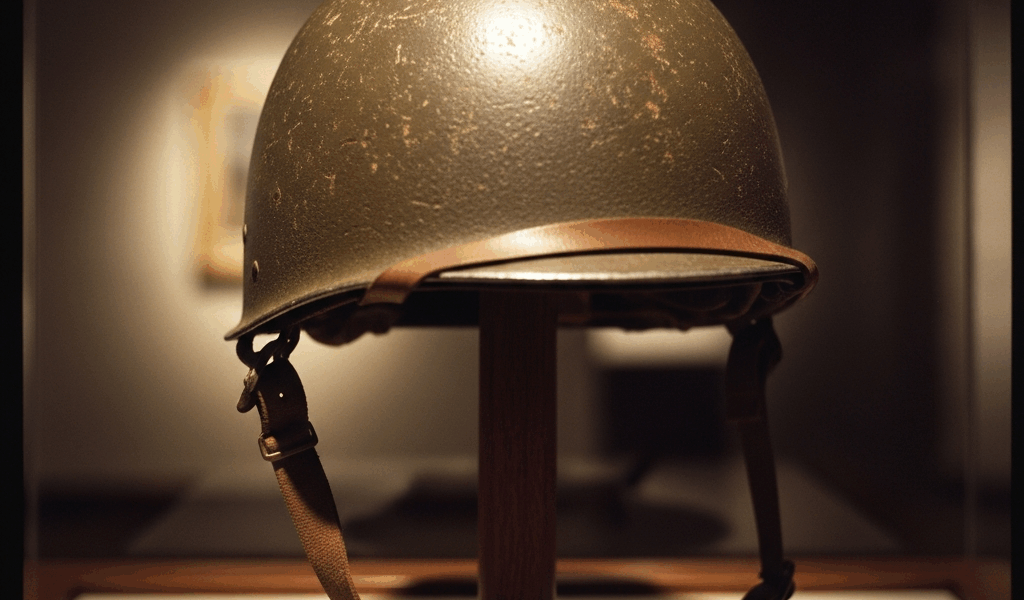
You are holding an M1 helmet and trying to figure out if it is worth $50 or $2,000. The answer depends on three things: which era it was manufactured, whether it is an infantry or paratrooper configuration, and whether the liner matches the shell. Get those three factors right and you can value any M1 helmet within minutes.
The M1 was produced from 1941 to 1985 — over four decades of production. Not all M1 helmets are created equal, and the difference between a common Vietnam-era shell and a WWII paratrooper configuration is the difference between $35 and $2,500.
M1 Helmet Timeline — Shell and Liner Eras That Determine Value
The three main shell manufacturers were McCord Radiator and Manufacturing Co. (most common), Schlueter Manufacturing, and International Harvester. McCord shells appear most frequently in collections and at shows. Each manufacturer stamped shells with specific markings — look on the interior of the rim.
1941 models: fixed bail (the wire chinstrap attachment welded directly to the shell), narrower rim profile. These are the earliest and most valuable standard-production shells. The fixed bail is the quickest identifier — if the bail does not swivel, you are looking at an early-war helmet.
Late-war models (1943–1945): swivel bail replaced fixed bail, slightly different rim roll. Still valuable as WWII production but more common than 1941 fixed-bail examples.
Korean War era (1950–1953): same basic design, different heat stamp codes. Worth $100–250 in good condition with matching liner. Not as sought-after as WWII production.
Vietnam era (1960s–1970s): mass-produced with minor manufacturing changes. These are the most common M1 helmets on the market. Shell-only value: $25–50. Complete set with liner: $35–75. Unless the helmet has documented unit markings or combat provenance, Vietnam-era M1s are entry-level collector pieces.
Paratrooper vs Infantry — The $1,500 Difference
The single biggest value differentiator in M1 helmet collecting is whether the helmet has a paratrooper (airborne) configuration. A WWII-era paratrooper M1 in good condition sells for $800–2,500. The equivalent infantry M1 from the same era sells for $100–400.
The key identifier is the A-bail — a flat metal bail rather than the round wire bail used on infantry helmets. The A-bail chinstrap attachment points are positioned differently to accommodate the airborne chinstrap system, which needed to stay secure during a parachute opening shock.
Warning: A-bails have been transplanted onto standard infantry shells to create fake paratrooper helmets. This is one of the most common upgrades in the M1 market. Check the bail attachment points closely for signs of recent welding, grinding, or modification. Original A-bail welds have a specific appearance from factory production — hand-welded replacements look different under a loupe.
Liner Identification and Value
The liner is the inner fiberglass or Hawley composite shell that sits inside the steel outer shell. Liner manufacturers include Westinghouse Electric (most common), General Plastic Manufacturing, and Capac Manufacturing Co. Each stamped their liners with manufacturer marks and production codes.
The most valuable configuration is a matched set — a shell and liner pair that were together from the factory, with original chinstrap and original suspension webbing intact. Unit markings painted on the liner add significant value when provenance can be confirmed.
Watch for post-war liners paired with WWII shells. Vietnam-era liners are nearly worthless ($5–15) and frequently appear in sets with WWII shells, which significantly devalues the overall helmet. Check the liner stamps against known production periods — if the liner dates to 1967 and the shell dates to 1943, the set was assembled after the fact.
Price Guide — What M1 Helmets Actually Sell For
Current market values (2025–2026 auction results and dealer pricing):
Common WWII infantry shell only: $75–150. WWII shell plus matched liner, all original: $200–450. Named or unit-marked WWII set: $400–1,200 depending on unit significance. Paratrooper configuration (A-bail) WWII: $800–2,500. Special marking helmets (sniper cover, D-Day mesh netting): $1,500–4,000+. Korean War era complete set: $100–250. Vietnam era complete set: $35–75.
Anything with documented soldier provenance — a named helmet with supporting discharge papers, photographs, or unit records — commands a premium of 2–5 times the base value for that configuration.
For current market pricing, check recent sold prices on Rock Island Auction and James D. Julia. Asking prices at shows and on eBay are not reliable indicators — sold prices are. Filter eBay by “sold listings” to see what helmets actually transacted for, not what sellers hoped to get.
Reproduction and Fake Detection
Steel weight: authentic WWII M1 shells are manganese steel weighing approximately 2.7 pounds for the shell alone. Reproduction shells are often lighter (stamped from thinner steel) or heavier (thicker modern steel). A kitchen scale is a useful first check.
Surface finish: authentic WWII shells have a sand-textured surface from the original paint application process. Reproduction shells often have a smoother base surface even when artificially aged. Run your thumb across the surface — the authentic texture feels like fine sandpaper under old paint.
Rim stamps: authentic shells have manufacturer stamps at specific locations with consistent depth and spacing. Reproduction stamps are often too uniform, too deep, or positioned incorrectly compared to known originals.
The most common fakes on the market: Eastern European reproduction shells sold as “barn finds” and Korean War-era shells misrepresented as WWII production. Always verify the era-specific construction details — bail type, rim profile, stamp locations — against known authentic examples before purchasing.

Stay in the loop
Get the latest military memorabilia market updates delivered to your inbox.