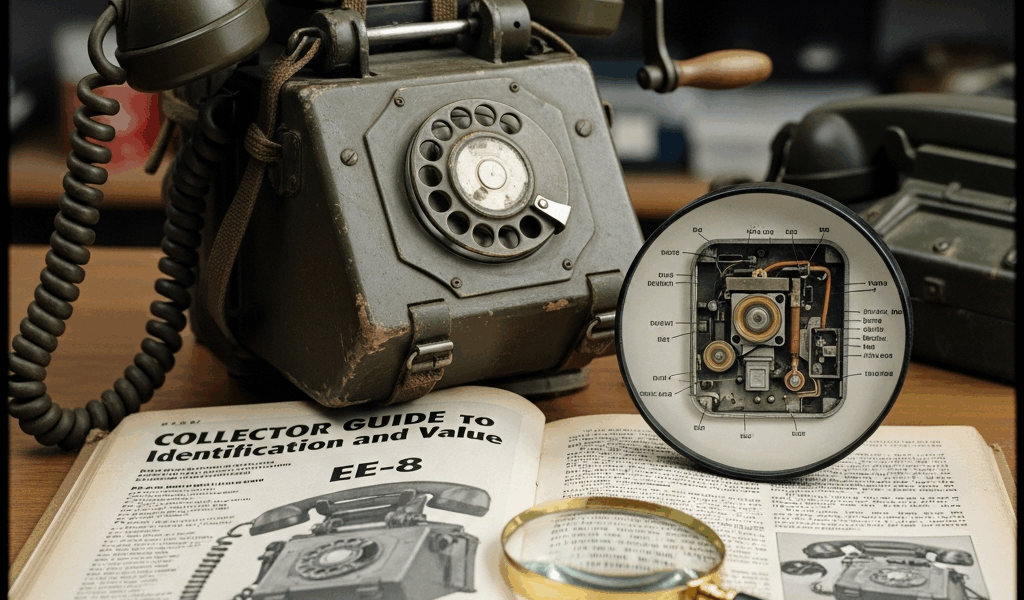
WWII Field Telephone EE-8 — Collector Guide to Identification and Value
Collecting WWII field telephones has gotten complicated with all the misinformation flying around. As someone who’s bought and sold probably forty EE-8s over the years — hauling them home from gun shows in Columbus, digging through estate sale boxes in rural Ohio, losing sleep over eBay auctions at midnight — I learned everything there is to know about this particular piece of American military history. I still watch collectors hand over $300 for an incomplete EE-8-A that’s worth half that. Or pass on a genuinely rare leather-case original because they couldn’t read the data plate. This guide is what I wish had existed when I started. Variants, condition, real dollar figures, where to actually find these things. Think of it like how a serious coin collector approaches the Morgan dollar series — same energy, different rabbit hole.
This article includes affiliate links. We may earn a commission at no extra cost to you.
EE-8 Variants and How to Identify Them
The EE-8 wasn’t a single telephone. But what is the EE-8, exactly? In essence, it’s a portable, hand-cranked magneto field telephone designed for military tactical communication. But it’s much more than that — it’s a three-variant family that evolved across a decade, and getting the variants wrong means mislabeling your piece, pricing it badly, and getting called out by the collectors who actually know the difference.
The Original EE-8
The baseline EE-8 entered service around 1939, produced into the early war years. The case is the telling detail — full leather construction, sewn carrying strap, brass hardware throughout. The lid secures with a leather tab-and-stud closure. Inside, the handset sits in a formed leather cradle. The telephone body itself is a metal casting in flat olive drab paint. On the front face, below the handset hook, sits a riveted data plate. On a genuine EE-8, it reads “TELEPHONE, FIELD, EE-8” alongside a contract number, manufacturer name, and year. Contract numbers with a “W” prefix followed by a string of digits — those are Army Signal Corps contracts. That’s what you want to see.
Manufacturers on the original EE-8 include Western Electric, Automatic Electric, and Leich Electric. Western Electric examples turn up most often. Leich examples — made in Genoa, Illinois, of all places — surface less frequently and generate extra collector interest just from the scarcity angle. That’s what makes regional manufacturing quirks endearing to us collectors.
The EE-8-A
The EE-8-A is the variant most collectors will actually encounter. Production ramped hard after Pearl Harbor, and the EE-8-A shows it — wartime manufacturing realities baked right into the design. The leather case gave way to a canvas-and-leather hybrid. Canvas body, leather flap, leather strap reinforcements. Very late examples are almost entirely canvas. Internals were simplified, certain components consolidated. The data plate reads “TELEPHONE, FIELD, EE-8-A” — that designation is right there in black and white if the plate is still legible. Date codes run 1941 through roughly 1944. Stromberg-Carlson entered the manufacturer list here, along with smaller Signal Corps contractors.
Don’t make my mistake. Early in my collecting, I bought an EE-8-A listed as an “original EE-8” by a dealer who either didn’t know better or didn’t particularly care. The leather case was a reproduction somebody had fitted — nicely done, honestly, but wrong. Paid $225 for something worth $110. Examining the data plate before committing to a price is non-negotiable. Full stop.
The EE-8-B
The EE-8-B is the postwar variant, produced into the early 1950s for Korea-era use. Construction quality actually improved — the wartime shortcuts got reversed. Cases went back to higher-quality materials. Subtle changes appear in the handset design and mounting hardware. Data plates reflect postwar contract numbering and manufacturer addresses from the late 1940s and early 1950s. For WWII-specific collectors, the EE-8-B lands at the bottom of the desirability ladder. It’s a legitimate piece of Cold War militaria — don’t get me wrong — but don’t let a seller charge you WWII premiums for a postwar unit. Happens more than it should.
Reading the Data Plate — What to Check
- Variant designation — EE-8, EE-8-A, or EE-8-B clearly stamped
- Manufacturer name and city of manufacture
- Contract number — “W” prefix indicates WWII Army procurement
- Year of manufacture — confirms the unit matches the case and components
- Inspector’s acceptance stamp — a small “flaming bomb” ordnance symbol or inspector cartouche
Probably should have opened with this section, honestly. The data plate is everything. A legible, complete plate on an EE-8 or EE-8-A adds real, tangible value. A missing or damaged plate raises questions nobody can answer cleanly — and those questions come out of your wallet.
Condition Grading for EE-8 Telephones
I think about EE-8 condition in five practical tiers — borrowed loosely from numismatic grading, adapted for how collectors actually talk about these pieces at shows and in private sales. There’s no official militaria standard the way there is for coins. What follows is the real-world framework.
Mint or Near-Mint — Unissued Examples
These exist. Warehouse finds surface occasionally — units packaged, stored, never issued to actual troops. The leather or canvas shows zero field wear. Data plate is crisp, fully legible. Handset cord is supple rather than brittle. The telephone functions — crank turns smoothly, magneto generates voltage, battery compartment is clean with no corrosion. Unissued examples in original packaging sit at the very top of the market. They’re rare. When you find one, it almost looks wrong — too good, somehow.
Excellent — Used But Carefully Preserved
This is what serious collectors are actually hunting. Honest wear on the case — some scuffing on the leather, minor canvas fraying — but structurally sound, closure hardware working, nothing cracked or broken. Original handset, intact cord, functioning telephone. Legible data plate. These belonged to someone who actually used a field telephone and took care of their equipment. You can feel the difference when you handle one.
Good — Standard Collectible Grade
The bulk of the market lives here. Obvious case wear, possibly some leather drying or canvas fading, but holds together. The handset may show crazing on the Bakelite — that brown, fine-cracked surface that develops on aged Bakelite over decades. The telephone probably functions, though the crank may be stiff. Data plate legible with some edge corrosion. Battery compartment clean or with minor surface oxidation. Displayable. Honest. Nothing to be ashamed of.
Fair — Incomplete or Damaged
Missing components drop a piece into this tier fast. A replaced handset, broken case hardware, missing strap, active corrosion in the battery compartment — any single one of these hits the value hard. Fair examples work for casual display or for someone who wants to restore and actually use the telephone. Not the right call if originality matters to you.
Poor — Parts or Display Only
Non-functioning telephone, substantial case damage, missing or illegible data plate. Parts source. Conversation piece. Not much else.
The Specific Details That Move the Needle
- Leather case condition — cracked, hardened leather drops value more than almost anything else
- Handset completeness — original handset with original cord matters; replacements are visible to experienced eyes
- Battery compartment — corrosion here is common and ranges from cosmetic to structural
- Crank function — a working magneto is a meaningful plus
- Original accessories — the line reel, infantry field wire, canvas accessory pouch all add value
- Unit markings — stenciled unit designations or serial numbers from specific Army units add provenance interest that serious collectors will pay for
Current Market Value in 2026
Real numbers from actual transactions — not aspirational asking prices. There’s a consistent gap between what dealers ask and what pieces actually sell for. Understanding that gap is the whole game.
What EE-8 Telephones Actually Sell For
A complete, fully functional EE-8-A in Excellent condition — good case, original handset, legible data plate, working crank — sells in the $175 to $250 range through online auction channels when properly described and photographed. The same piece at a militaria show might have a $300 tag on it. A new collector might pay it. Experienced collectors walk away from $300 on an EE-8-A unless something is genuinely exceptional about it — and they’ll tell you exactly why as they walk away.
Good condition examples — displayable but honestly worn, no accessories — move in the $85 to $140 range online. At shows, expect to haggle from a $150 to $175 ask down to something reasonable if you’re patient and polite about it.
Fair condition pieces — bad case, replaced handset, non-functioning — land in the $45 to $75 range. They sell. Just to a different buyer.
The original EE-8 with a genuine all-leather case in Excellent condition commands a real premium. I’ve seen these move at $350 to $450 when everything checks out and the provenance is clear. Unissued examples in any variant can push $500 and above — especially with original cardboard packaging, which troops generally threw away the moment they opened the box. That packaging survived despite all odds, and collectors pay accordingly.
EE-8-B postwar examples in comparable condition run about 20 to 30 percent below EE-8-A prices. The Korean War collector crowd wants them. The WWII premium simply isn’t there.
Auction Results vs. Dealer Prices
eBay completed sales are your baseline — pull the completed listings, filter for “sold,” and you have an honest market snapshot with no guesswork. Dealer prices at IMA-USA or similar operations reflect retail markup. Budget 40 to 60 percent above the auction baseline for the convenience of buying from someone with a returns policy and a reputation to protect. That markup is sometimes worth paying. It’s not always worth paying. You’ll develop a sense for when.
Where to Buy and Sell EE-8 Telephones
Militaria Shows
The best place to learn — and one of the harder places to buy well if you’re still new. Shows like the OVMS show in Columbus or the MAX show in Baltimore pull serious dealers and serious collectors. You can handle pieces, compare examples side by side, and have actual conversations with people who’ve been doing this for thirty years. The downside is that prices at the better shows tend toward dealer retail rather than auction reality. Bring your knowledge, not your checkbook, until you’ve walked the room at least twice.
Frustrated by a fruitless morning wandering the OVMS show floor years ago, I nearly left early — then stumbled across a near-complete EE-8 with original leather case and all accessories tucked under a dealer’s table in the last hour. He was clearing space and wanted it gone. Paid $165 cash. Last-hour deals at shows are real. Patience is underrated as a collector skill.
Online Auctions — eBay
Deepest liquidity in the market. Everything from unissued warehouse finds to stripped parts pieces. The problem — photographs hide condition issues that are immediately obvious in person. Brittle handset cords photograph fine. Case cracks hide in shadows. Spend serious time on completed sales research before bidding, ask sellers for additional photos of the data plate and battery compartment specifically, and check the return policy before you commit. For selling, eBay reaches the widest audience, but fees — currently around 13.25 percent in the collectibles categories — take a real bite.
IMA-USA and Coleman’s Military Surplus
International Military Antiques and Coleman’s are the established specialty dealers. They grade conservatively, describe accurately, and stand behind what they sell. You pay for that — their EE-8 listings will be at the top of the market or slightly above it. For a buyer who wants confidence without handling the piece first, the premium is often justified. For sellers, these dealers buy in volume and typically offer 40 to 60 percent of their retail asking price. Convenient. Not maximum return. Pick your priority.
Facebook Groups and Specialty Forums
While you won’t need a dealer account or professional credentials, you will need a handful of reference points before buying from these channels. Militaria collectors maintain active Facebook groups — search “WWII militaria collectors” and you’ll find several with tens of thousands of members. Transactions happen directly between collectors, which means better prices moving in both directions. Vetting is informal. Know who you’re buying from before the money moves. The USMF — US Militaria Forum — is older, more text-based, and packed with people who can identify a variant or authenticate a piece in a thread within hours. Invaluable for research. Also an underused buying and selling channel, apparently.
The EE-8 might be the best entry point into WWII communications collecting, as the hobby rewards patience and specific knowledge. That is because the variant system gives you a genuine framework — something to learn, something to chase, a reason to look twice at every piece you encounter. Buy the best condition you can afford, learn to read the data plate cold, and don’t pay EE-8 prices for an EE-8-B. Everything else follows from there.

Stay in the loop
Get the latest military memorabilia market updates delivered to your inbox.