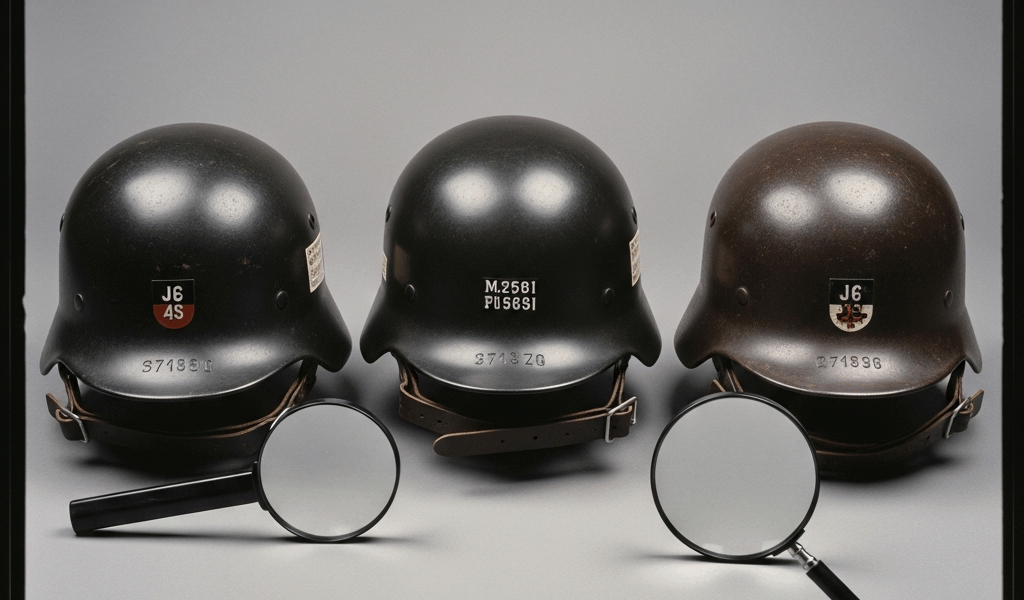
WWII German Helmet Markings — What Collectors Should Know
WWII German helmet collecting has gotten complicated with all the reproduction noise flying around. As someone who spent three years confidently misidentifying M35s and showing friends “authenticated” pieces that turned out to be well-made fakes, I learned everything there is to know about maker codes, decal placement, and liner marks the hard way. Today, I will share it all with you.
The knowledge breaks down into five concrete areas: physical shell differences between models, decal systems by branch, manufacturer stamps, liner authentication marks, and reproduction tells. Master these five things, and you’ll spot fakes before your wallet ever opens.
M35 vs M40 vs M42 — How to Tell Them Apart
Probably should have opened with this section, honestly. The three main German steel helmet models span 1935 to 1945. They look similar at first glance. They’re not — and the differences are right there under your fingertips if you know what to feel for.
The M35 entered service in 1935 and ran through 1940. Its ventilation bale — the small metal lugs on either side where the liner attaches — sits relatively flush and rounded against the shell. The rim is unrolled. That means the steel edge at the bottom is flat and sharp, not folded. Shell thickness runs 0.8 to 1.0 millimeters. Many M35 examples also carry a visible seam line down the center back where two stamped halves were joined. That seam is worth looking for.
The M40 is the mid-war standard. Introduced in 1940, produced through roughly 1943. The bale changed — more squared off, more pronounced. But what separates the M40 from everything before it is the rolled rim. That bottom edge was folded inward, creating a smooth lip. Not cosmetic. It actually reduced cuts and abrasions in the field. Shell thickness crept up to 0.9 to 1.1 millimeters, and improved stamping dies eliminated the center seam on most examples.
The M42 ran from 1942 until the war ended. Its bale goes even more angular and pronounced. Rolled rim continues. But here’s what trips up collectors — the M42 shell is noticeably thinner. Sometimes as low as 0.65 millimeters. That wasn’t a design decision. That was material scarcity catching up with German production. The paint tends to be thinner and less consistent on M42 shells for the same reason.
Run your finger along the bottom edge of any helmet you’re evaluating. Unrolled means sharp. Rolled means smooth and folded inward. That tactile difference alone resolves more misidentifications than anything else in this guide. Don’t make my mistake and skip this step because the helmet looks right.
Decal Types and What Branch They Indicate
But what is the Wehrmacht decal system? In essence, it’s a branch-identification scheme applied to the right side of the helmet shell. But it’s much more than that — it’s one of the fastest authentication tools you have, because fakers get it wrong constantly.
Standard Wehrmacht helmets received one shield on the right side — the side facing right when worn. This shield showed the national eagle and swastika. Color varied by branch and production period: white or gray for Heer, lighter blue for Luftwaffe, a darker metallic presentation for Kriegsmarine. That’s what makes the color variation endearing to us collectors — it tells a story about where that helmet lived.
Some helmets received double decals. Wehrmacht shield on the right, SS rune decal — two lightning bolts — on the left. That indicated an SS unit soldier. The rune appeared in white, silver, or light gray depending on production batch.
Here’s the critical part: by mid-1943, the Wehrmacht phased out double decals entirely. Single decal shields only from that point forward. So if you’re handling an M42 shell with both Wehrmacht and SS decals, you’re probably holding a reproduction. Period examples with double decals on M42 shells do exist — but they’re genuinely scarce. Most double-decal M42 helmets circulating today are post-war fakes. Full stop.
Authentic decal application shows specific wear — paint loss at the edges consistent with storage and handling, not uniform fading across the whole shield. Under magnification, the paint has a slightly raised, tactile quality where brush strokes are visible. Run your thumbnail along the edge of an authentic decal and you feel that paint buildup. Reproduction stickers sit perfectly flat and feel smooth and integrated into the shell. Original application, done on wartime assembly lines under pressure, never produced perfect color uniformity either. Reproductions often achieve suspiciously even color saturation — which is actually the wrong look.
Maker Codes and Lot Numbers Inside the Shell
German manufacturers stamped identification marks inside every shell. These codes are your most direct path to authentication and dating — so learn them cold.
The most common manufacturer codes:
- ET — Eisenhüttenwerke (major producer, Berlin)
- NS — Neuwerk Stahlwarenfabrik (Solingen)
- SE — Sächsische Emaillierwerke (Dresden)
- Q — Quist (another major Berlin manufacturer)
- CKL — C. Kellner & Söhne (Suhl)
- EF — Emaillierwerke Fulda
- Double stamps (two maker codes on one helmet) — indicates rework or re-production runs
These codes appear stamped into the steel on the underside of the rim — typically left side or back. The stamp should show clear pressure indentation you can feel. Not painted on, not lightly etched. Deep and sharp. Reproductions often paint maker codes rather than properly stamping them, and the letters look thin and flat. Hold the rim to a light source and drag your fingernail across the letters. Real stamps create tactile indentations. Painted codes don’t.
Next to the maker code sits the lot number — a two to four-digit batch identifier. Then the size stamp. Standard sizes ran 55, 56, 57, 58 centimeters. Reading German helmet size stamps took me an embarrassingly long time to figure out, honestly. A “56/56” stamp means 56cm diameter, 56cm depth. Both numbers matter.
Date stamps appear as month and year abbreviations. A stamped “5/42” means May 1942. Some helmets show only the year. ET helmets tend toward more complete dating than NS examples — just one of those production quirks worth knowing.
Liner Stamps and Hardware That Confirm Authenticity
The leather liner band tells you as much as the shell itself. This is where field replacements and post-war alterations become obvious — if you know what you’re looking at.
Original liners show maker marks stamped into the leather. These correspond to the leather supplier, not the helmet manufacturer. Common liner maker marks include “RUM,” “BA,” and “LS.” The date stamp on the liner band indicates when the leather was produced — typically several months before the shell. A liner stamped “1/41” inside an M42 shell dated “12/43” is a red flag. Liner dates should roughly match or slightly precede shell dates. When they don’t, start asking questions.
Chinstrap hardware — brass or steel rivets, the buckle mechanism — should show appropriate wear and patina. Original brass develops a specific greenish patina over 75-plus years. Shiny, new-looking hardware on an otherwise aged helmet suggests recent replacement. That doesn’t automatically mean fake, but it does mean field restoration, which affects both authenticity assessment and pricing significantly.
Many post-war helmets received re-lining. American occupation forces, souvenir hunters, museum conservators — all installed new liners at various points. A re-lined helmet is worth considerably less than an original-liner example. Spotting re-lining: replacement liner stitching shows machine-thread consistency. Original hand-stitching varies slightly, with visible needle marks and occasional irregularities. The leather on originals darkens and hardens in specific ways — replacement leather, even deliberately aged leather, never quite replicates that particular patina.
Common Reproduction Tells and How to Spot Fakes
Reproductions exist at every price point. Some are crude. Others are sophisticated enough to fool collectors who haven’t handled enough originals. So, without further ado, let’s dive in to what separates them.
I’m apparently someone who notices decal placement immediately, and catching it wrong never gets old while seeing it right never reassures me quite enough. The most common reproduction mistake: Wehrmacht shields placed on the left side instead of the right. Fakers also add both eagle and SS rune decals in combinations that never existed in authentic production — and as mentioned, those decals sit flat against the shell rather than showing the dimensional quality of hand-applied wartime paint.
Paint texture is another tell. Real WWII helmets show varied texture depending on storage conditions, environmental exposure, and decades of age. Some areas glossy, others flat. Reproduction shells often receive uniform modern spray paint that lacks this complexity entirely. Under natural light, authentic helmets show a finish variation that modern paint simply can’t replicate at scale.
Liner materials betray many reproductions immediately. Some fakers use modern synthetic leather or nylon. Authentic liners are vegetable-tanned leather — specific brittleness, specific color, specific smell. If the liner feels soft, pliable, or vaguely plastic-like, you’re holding a modern replacement. Original liners feel stiff and smell distinctly of aged leather. That smell is actually useful.
Shell steel uniformity catches reproductions too. Original helmets, stamped by mechanical presses with finite tool life, show slight thickness variations and surface texture inconsistencies. Reproductions sometimes achieve too-perfect uniformity — especially cast versions, which lack the deformation patterns visible at the shell edges on genuine stamped examples.
While you won’t need laboratory equipment, you will need a handful of reliable tools — a good loupe at 10x magnification, calipers for measuring shell thickness, and a UV light for spotting modern paint. That last one might be the best option, as authentication requires spotting modern materials fast. That is because UV light causes modern synthetic paints and reproduction stickers to fluoresce in ways period materials don’t.
Quick Authentication Checklist
- Rim rolled or unrolled? Does it match the claimed production period?
- Maker code stamped — not painted — into shell underside?
- Date stamp logical relative to helmet model?
- Decal on correct side (right for Wehrmacht, double placement only for pre-mid-1943 SS)?
- Decal shows dimensional paint buildup, not flat sticker appearance?
- Liner leather shows appropriate age, patina, and stiffness?
- Liner date roughly matches or precedes shell date?
- Hardware shows period-appropriate patina — no suspiciously shiny buckles?
- Overall paint texture shows complexity and variation under natural light?
- No anachronistic details — M42 double decals, M35 rolled rim, mismatched size stamps?
First, you should run through this checklist before handing over any money — at least if you want to avoid expensive mistakes. A helmet clearing all ten points isn’t a guaranteed original. But failing even two should raise serious questions. Trust your eyes. Trust the tactile feedback from stamps and decal edges. Trust the wear patterns that develop over 75-plus years in ways no faker has successfully replicated at scale. Don’t make my mistake and trust the seller’s story instead.



Stay in the loop
Get the latest military memorabilia market updates delivered to your inbox.