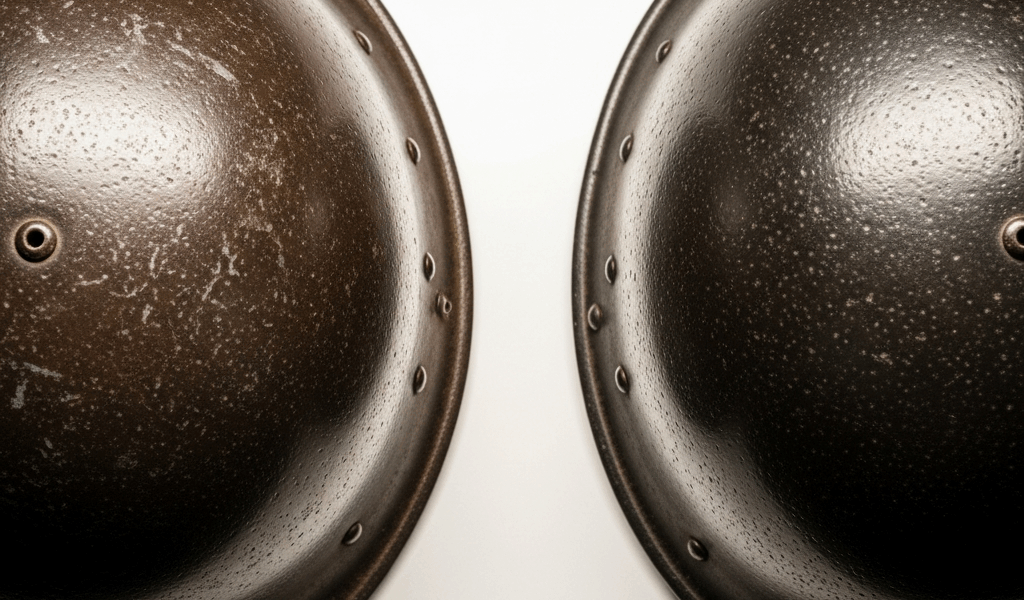
Why the M1 Helmet Gets Faked More Than Almost Anything Else
M1 helmet collecting has gotten complicated with all the convincing reproductions flying around. And honestly, it’s been that way for decades — fakers have had since the 1970s to perfect their craft, which means the market is now genuinely treacherous for anyone who doesn’t know what they’re looking at.
But what is the M1 helmet, exactly? In essence, it’s the standard-issue steel pot worn by American soldiers from 1941 through the end of WWII — and beyond. But it’s much more than that. It’s the crown jewel of American militaria collecting. Museums want it. Hollywood props departments grab them off eBay. That visibility, combined with the sheer volume produced, made it the obvious target for overseas reproduction manufacturers pumping out shells for $40–$80 a unit. Slap on a chinstrap, hit it with some artificial patina, and suddenly that same helmet is listed for $300 or $400. The profit margin is brutal. That’s why learning to spot a fake M1 isn’t some academic exercise — it’s survival.
Check the Bail First — It Tells You Almost Everything
The bail is the steel loop holding the liner inside the shell. Look at it first. Not last. First.
Original M1 shells produced between 1941 and mid-1944 use a fixed bail — welded solid to the shell. The weld bead sits visible on both the inside and outside where the bail attaches. It’s not pretty. It shouldn’t be. The weld has an uneven, hand-done character that screams 1942 factory floor. Reproductions often show too-clean welds or skip the weld entirely, substituting a rivet or some modern fastener that would have confused a wartime quartermaster.
Late 1944 brought the swivel bail design. This bail rotates on a pin, letting the liner move independently. Authentic swivel bails use a cotter pin — not a modern split ring — and the bail sits at a specific angle relative to the shell rim. Reproduction swivel bails get the fasteners wrong almost every time. The rotation feels off too. Too tight, too loose, or the pin sits slightly crooked in a way that’s hard to articulate but immediately obvious once you’ve handled a real one.
Grab a jeweler’s loupe or use your phone’s macro setting. Real welds show slightly rough surfaces, visible metal grain variation, minor inconsistencies. Reproductions show uniform, almost stamped-looking attachment points — the kind of precision that simply didn’t exist in wartime manufacturing. The metal gauge matters here too. Original bails are heavier, thicker steel. Repo bails feel flimsy, and they sound thin when tapped — almost hollow.
Probably should have opened with this section, honestly. The bail alone eliminates 60% of fakes without even touching the shell markings.
Shell Markings, Stamps, and What Originals Actually Look Like
The inside of the helmet shell carries heat stamps identifying the manufacturer. Two companies made them: McCord Manufacturing and Schlueter Manufacturing. That’s it. Those stamps are where authentication gets granular — and where reproductions typically fall apart.
Authentic McCord stamps appear inside the shell’s dome, usually toward the back. Shallow lettering — stamped under heat and pressure, not engraved. The font is utilitarian, slightly irregular. Original stamps from the 1940s show wear, fading, sometimes incomplete impressions because the metal wasn’t perfectly positioned every single time on a wartime production line running 24 hours. The text reads “McCORD MFG. CO.” alongside a lot number and month/year code. Something like “7-43” for July 1943.
Schlueter stamps are similarly shallow, positioned slightly differently inside the shell. Same general font characteristics — utilitarian, not crisp. Nothing about them says precision.
Reproductions betray themselves here consistently. Modern stamping equipment is too good. Reproduction stamps look like they were pressed yesterday afternoon. Letters uniformly deep, impression perfectly centered, font almost robotic in its cleanliness. Some reproduction manufacturers also place stamps in locations where originals never appear — or use lot number sequences that simply didn’t exist between 1941 and 1945.
One thing worth knowing: absence of a stamp isn’t automatically a red flag. Some late-war production runs skip the manufacturer marking entirely. But if you see a stamp, study it under bright light. Bring a magnifier. Real stamps show inconsistency. Fake ones show perfection. That distinction is everything.
Liner, Chinstrap, and Hardware Red Flags
The steel shell is only half the helmet. The liner assembly — the inner canvas and webbing structure — is where you catch most reproduction hybrids. And this is where I personally got burned early on.
Original liners came from Westinghouse, Inland, and a handful of other wartime suppliers. The chinstrap buckle appeared in two main types: an earlier painted steel buckle and a later chromed version. The webbing itself is cotton or linen with specific stitching patterns — hand-done, which means slight variations, skip stitches, uneven thread tension throughout. That imperfection is the authentication.
Reproduction liners use synthetic webbing that looks too uniform, too new. Machine-perfect stitching. The chinstrap buckles are either poorly cast — rough texture, uneven surfaces — or made from zinc-plated steel that looks nothing like original hardware. I’m apparently sensitive to buckle weight, and original hardware works for me as an authentication cue while reproduction buckles never feel quite right when you set them against a genuine example side by side.
Don’t make my mistake. I assumed early on that if the shell was original, the liner would be too. It won’t be. Mixed helmets are everywhere — an authentic McCord shell married to a modern reproduction liner. The shell authenticates fine. The liner is obviously fake. That helmet now fetches maybe 40–50% of what a fully intact original commands. Condition matters. Originality matters more.
Strip the liner carefully and examine the webbing attachment points. Original webbing shows nail holes or rivet holes from factory assembly. Reproductions often glue the webbing on, or the attachment points sit in entirely the wrong locations — a detail that’s easy to miss and easy to verify once you know to look for it.
What to Do If You Are Still Not Sure
So, without further ado, let’s say you’ve examined the bail, magnified the stamps, turned the liner inside out — and you’re still uncertain. That’s normal. Even experienced collectors send reference photos to forums before committing to a purchase. The uncertainty doesn’t mean you’re doing it wrong.
While you won’t need a full conservation lab, you will need a handful of reliable resources. Originals & Reproductions: A Collector’s Guide to WWII U.S. Helmets by Chris Arnold might be the best option, as M1 authentication requires specific visual references. That is because photographs of real versus fake stamps, bails, and hardware will train your eye faster than any written description — including this one. It runs around $45–$60 depending on where you find it. Worth every dollar.
Post clear photos on the U.S. Militaria Forum (USMF) or Warrelics. Contributors include collectors with decades of hands-on time. They’ll catch reproduction tells you missed. Overhead shots of the bail attachment, side profile shots, close-ups of any stamps, liner hardware photos from multiple angles — give them everything.
First, you should buy from reputable dealers who provide provenance documentation and accept returns — at least if you’re spending serious money. Yes, you’ll pay a premium. A dealer guaranteeing authenticity has skin in the game. A private seller on Facebook Marketplace doesn’t. That asymmetry of accountability is worth the price difference almost every time.
Even seasoned collectors have been burned by sophisticated reproductions. That’s what makes the M1 endearing to us collectors — it rewards genuine study and punishes shortcuts in equal measure. The fact that you’re asking these questions already puts you ahead of most buyers walking into a militaria show with their checkbook out.


Stay in the loop
Get the latest military memorabilia market updates delivered to your inbox.