WWII US Army Mess Kit — How to Identify and Value Yours
Collecting WWII mess kits has gotten complicated with all the reproductions and misidentified surplus flying around. I picked up my first one at an estate sale outside Harrisburg, Pennsylvania — paid $8 for a dented pan with no visible markings. The seller thought it was a camping piece. I thought maybe she was right. Spent the better part of three months digging through collector forums, military surplus catalogs, and a surprisingly helpful veteran’s Facebook group before I realized I’d been holding a $40 minimum the whole time. That’s if the contractor stamp had been legible, which it wasn’t. Today, I will share it all with you — five years and roughly 60 mess kits later, the whole picture.
What a Real WWII Mess Kit Actually Looks Like
But what is a genuine WWII mess kit? In essence, it’s two hinged aluminum pieces — a pan running about 9.5 by 6.5 inches and a shallower lid that pulls double duty as a plate. But it’s much more than that. When closed, the whole assembly sits around 1.25 inches thick, compact enough to clip onto webbing or a field pack without catching on everything. The handle is folded aluminum, riveted to the pan’s upper edge. Open it and the lid swings on a hinge pin. The handle becomes your grip on the entire assembly.
Construction is aluminum alloy across the board. Weight is your first gut check. A real piece feels substantial without being heavy — somewhere between 14 and 18 ounces depending on the manufacturer and their specific alloy mix. Interior surfaces are smooth. Sometimes you’ll catch faint manufacturing lines. The exterior develops a natural oxide patina on field-used pieces, or holds a brushed aluminum finish if it spent the war sitting in quartermaster storage.
Dimensions are your hard filter. Don’t trust anything that measures significantly off. I once spent twenty minutes examining what a dealer called a “rare Pacific Theater variant.” Larger pan, thinner metal, wrong proportions entirely — it was a postwar Boy Scout camping kit. The devil genuinely does live in those measurements.
Reading the Contractor Stamps and Date Marks
Probably should have opened with this section, honestly. Contractor stamps are the single fastest authentication tool you have, and most new collectors skip straight to condition when they should start here.
Four contractors dominated legitimate WWII production: Vollrath, Aluminum Goods Manufacturing Company (AGMC), Wear-Ever, and Manning-Bowman. Vollrath stamps turn up most often — check the interior bottom of the pan first, then the handle. AGMC pieces tend to mark the hinge area or near the handle rivet. Wear-Ever shows up on the lid interior. Manning-Bowman examples are less common but follow the same interior base placement.
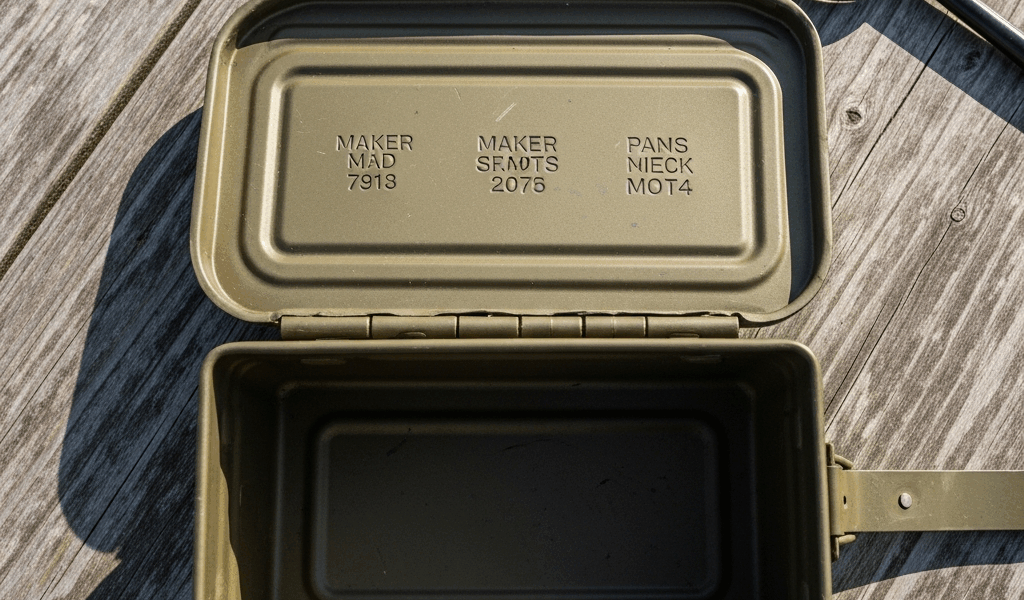
A typical Vollrath reads “VOLLRATH CO” followed by “U.S.” and a production code — something like “44” for 1944. Font is always crisp, pressed during manufacturing, never hand-stamped or uneven. Sloppy lettering means fake. No exceptions I’ve ever encountered.
Date codes vary by manufacturer. Vollrath used straight production years. AGMC ran similar year stamps. Other makers embedded dates inside patent numbers or contract designations. A piece marked 1942 or 1943 is authentic WWII production. Anything dated 1950 or later is Korean War surplus at best, postwar civilian at worst.
Unmarked pieces exist. Roughly 15 to 20 percent of field-used examples I’ve examined show worn or absent stamps — heavy use, chemical exposure, aggressive cleaning by a previous owner. Don’t write them off automatically. Authentication just shifts to hinge type, handle construction, and wear pattern analysis. Harder, but doable.
Hinge and Handle Variations That Date Your Mess Kit
Two hinge designs separate genuine WWII production from Korean War and civilian pieces. Learning both is non-negotiable.
Original WWII design used a simple pin hinge with a rolled edge on both the pan and lid. The pin itself was secured by a small cotter pin or bent ends — nothing elaborate. Examine it closely and the metal sits smooth, the pin flush. Production runs from 1942 through 1945 use this design almost exclusively. Handle attachment matches the same precision: two or three flush rivets, perfectly aligned, no variation between manufacturers.
Korean War kits from 1950 to 1953 introduced a slightly modified hinge — more pronounced collar around the pin, sometimes larger rivets with less careful spacing. Subtle difference. Handle 10 or 15 genuine WWII examples and you’ll see it immediately. That’s what makes hands-on experience endearing to us collectors.
Test the handle yourself. Open and close it. A genuine WWII piece folds so tightly the pan lip covers almost the entire handle. No rattle. No visible gap. Reproductions leave excess space. You can feel it before you even look for it.
Rivet quality is your secondary check. Military contractors used identical rivet specs across all WWII production — small, perfectly rounded, evenly spaced. Large rivets, irregular spacing, or visible solder instead of rivets means postwar civilian production. Walk away.
Condition Grades and What They Mean for Value
Market value on these kits runs a brutal range — $12 to $180 for essentially the same object. Condition is everything.
Field Used with Patina — Dents, scratches, oxide discoloration, maybe a faint rust bloom inside. Markings still readable or partially visible. $15 to $35 depending on stamp legibility and whether both pan and lid are present and functioning. Most common condition you’ll encounter at estate sales and flea markets.
Very Good Condition — Light wear, minimal denting, original aluminum finish mostly intact, clear markings, no rust, handle functioning smoothly. $45 to $75. Usually these saw limited field time or got stored carefully after the owner came home.
Unissued or Near Mint — Original finish nearly pristine, no visible wear, markings sharp and complete, hinge mechanism tight and silent. Rare. $80 to $150. Most examples in this range came out of unopened quartermaster crates or long-term depot storage.
Complete with Original Utensils — If the kit still has its original fork and spoon set — usually marked identically and attached via a small chain or loop — add $30 to $60 to whatever base value applies. Matched sets in original condition push past $180 consistently.
Don’t make my mistake. I soaked an otherwise excellent field-used piece in white vinegar to strip the patina — thought I was improving it. Destroyed the original finish entirely. Collectors pay premiums specifically for authentic oxidation and field patina. Over-cleaning makes a piece look postwar or civilian. If you acquire a patina-covered kit, leave it alone. The oxidation is the value.
Fakes, Reproductions, and Civilian Look-Alikes to Watch For
Three categories of non-authentic pieces circulate regularly. Know all three.
Postwar Civilian Camping Kits — Same basic shape, same function, made by companies like Coleman or BSA from the mid-1950s onward. The alloy gives them away first. Civilian aluminum oxidizes differently — dull gray instead of the silvery military patina. Stamps read “COLEMAN” or “BSA” instead of Vollrath or AGMC. Interior surfaces run rougher. Hinge pins are larger and less precise. Coleman kits also run slightly larger overall — dimensions again.
Modern Reproductions — These flooded the market around 2010 when genuine surplus dried up. I’m apparently detail-obsessed about fonts and the reproduction stamps always show it — letters too uniform, edges mechanically crisp, occasionally absurd date codes. I’ve personally seen “2008” stamped to approximate a vintage look. The metal itself feels wrong. Lighter. Thinner gauge. Hinges are either too loose or too stiff with nothing in between. Rivets lack the symmetry of actual military production.
Korean War Pass-Offs — Sellers misrepresent 1950 to 1953 pieces as WWII to justify higher prices. The hinge collar is your tell every time. Korean War pieces also show heavier field wear overall — most of them actually went to war. If markings show 1951 or later, it’s not WWII. Period.
So, without further ado, here’s the one actionable tip worth more than everything else combined: before buying at auction or online, ask for close-up photos of the hinge area, the handle rivets, and the interior base markings. These details are hardest to fake convincingly. A reputable seller sends those images without hesitation. If they won’t — walk. Authentic examples are plentiful enough and affordable enough that you never need to gamble on a mystery piece.



Stay in the loop
Get the latest military memorabilia market updates delivered to your inbox.