What Makes a WWII Canteen Worth Identifying
WWII canteen collecting has gotten complicated with all the reproductions and mislabeled estate sale finds flying around. Three years ago, I picked up a beat-up M1910 at an estate sale for $8. The seller shrugged when I asked what it was. Six months of research later, I’d authenticated it as a 1943 Excelsior manufacture — original wool cover still attached. That same canteen sold for $185 at auction. That’s why this matters.
This article includes affiliate links. We may earn a commission at no extra cost to you.
The spread between a reproduction and a genuine article can run $150 or more on a single canteen. Originals typically fetch $80 to $300 depending on maker, condition, and how rare the production run was. Reproductions? Usually $15 to $40. And they’re everywhere. Most collectors walk right past genuine pieces without recognizing them — or worse, pay premium prices for fakes because the seller said the right things.
Canteens are undervalued and underresearched compared to helmets or insignia. Honestly, that works in your favor. Maker marks, date stamps, and material composition don’t lie. You just have to know where to look and what the codes actually mean. So, without further ado, let’s dive in.
How to Read the Maker Marks and Date Stamps
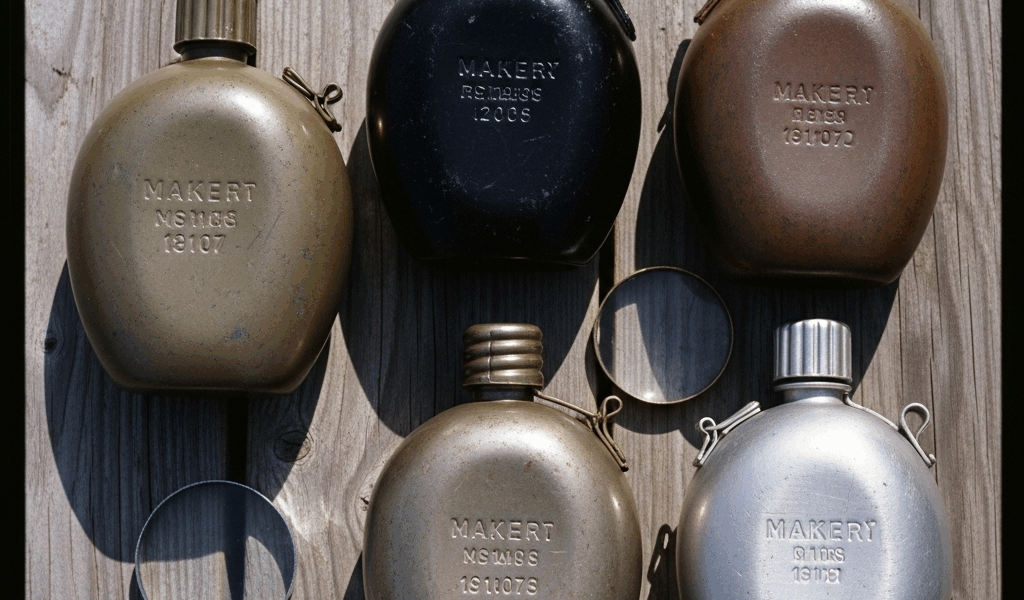
The U.S. M1910 canteen predates WWII but saw heavy service straight through 1945. Stamps typically appear on the bottom or lower side of the canteen body — a contractor code (usually two or three letters), a date stamp, sometimes a military acceptance mark. The contractor codes are your roadmap. Excelsior, Vollrath, and Canteen Corp of America were the dominant manufacturers during the war years.
Here’s what I learned the hard way: stamp position and depth matter enormously. Original stamps on authentic canteens sit flush and slightly recessed into the metal. They were stamped during manufacturing — part of the piece, not applied afterward. Reproductions often show shallow or raised stamps. Run your fingernail across one. A real stamp won’t catch. A fake usually will. Don’t make my mistake of skipping that step at shows.
The M1942 arrived mid-war as a lighter alternative. These carry maker marks in nearly identical locations but with slightly different formatting. Vollrath M1942s, for example, display “VOLLRATH” followed by the date code on the bottom. Date format matters too — “1943” appears as either “1943” or the abbreviated “43.” Fake stamps often use inconsistent spacing or wrong font weight. Your eye catches it once you know what clean looks like.
Date stamps on originals follow strict military specifications. Letters represent the month — A for January, B for February, and so on down the alphabet. Numbers indicate the year. A stamp reading “C43” means March 1943. That one code tells you the manufacturing window, the production pressure the contractor faced, even which factory shift probably assembled it.
Cross-Referencing Contractor Codes
Canteen Corp of America marked their pieces “CCA.” Excelsior used either “E” or the full “EXCELSIOR” stamped out. Vollrath went with “VOLLRATH” or just “V” depending on the model and year. Other known makers include National Presto, Columbian, and Granite Iron Ware — each with distinct stamp locations and formatting styles specific to their production runs. If a stamp format doesn’t match known patterns from any of these contractors, walk away. It’s almost certainly a postwar or reproduction piece.
I’m apparently someone who learns through repetition, and spending an afternoon cross-referencing five canteens against period manufacturing records worked for me while just eyeballing them never did. Three matched perfectly to known Excelsior production runs. Two didn’t match anything documented. Those two were both reproductions — acquired from different sellers months apart. I’d been proud of both finds. That stings less now than it did then.
Material and Construction Clues That Give It Away
Steel versus aluminum versus stainless tells a timeline story. Early M1910 canteens used steel. By 1942, aluminum dominated manufacturing — the government needed steel elsewhere, specifically for weapons production. The shift wasn’t absolute. You’ll find both materials in overlapping production years. But if you’re holding a steel M1942 stamped 1944, something’s off. Note it. Ask questions before buying.
The seam weld is revealing. Original canteens feature a continuous weld running down one side — straight, uniform in width, slightly raised from the surrounding surface. Reproductions show uneven welds, gaps, or seams that look cosmetic rather than structural. Modern reproduction techniques genuinely struggle to replicate period welding consistency. That inconsistency shows up every time under close inspection.
Stopper type and cap chain presence vary by era. Pre-1943 canteens often feature cork or wooden stoppers. Later war production shifted to bakelite — an early plastic — darker in color and denser in feel than modern plastics. The threaded metal cap should be securely welded to the chain. On reproductions, chain attachment points are frequently loose, or you’ll spot modern solder joints where period welds should be.
The wool cover is crucial context. Khaki wool covers appear on earlier production runs, roughly 1940 through 1942. Olive drab covers dominate 1943 onward. Period covers show uniform weave density and consistent thread color throughout. Reproduction covers reveal themselves through inconsistent dye lots, modern thread construction, or synthetic blends that feel wrong the moment you handle them against a genuine piece.
German and British Canteens — Quick Comparison for U.S. Collectors
Probably should have opened with this section, honestly. Too many collectors confuse Wehrmacht Feldflaschen with U.S. canteens at shows — especially newer collectors working from photographs rather than handling actual pieces. The shape alone gives it away. German canteens are bulbous, almost pear-shaped. U.S. canteens are flatter, more kidney-bean in profile. Hold them side by side once and you’ll never mix them up again.
German markings feature eagle stamps — Waffenamt acceptance marks — alongside manufacturer codes in German. The bakelite stopper on Wehrmacht canteens runs nearly black, noticeably darker than U.S. examples. Steel is standard on German pieces; aluminum variants are rare. Cover fabric is usually a darker wool, sometimes linen, never the khaki shade you see on American production.
But what is a British Mk. VI canteen? In essence, it’s a rounder, more refined-looking vessel sitting shape-wise between the American and German versions. But it’s much more than that — the formal, evenly-spaced stamping and the distinctive “broad arrow” acceptance mark make British canteens immediately recognizable once you’ve seen one. Steel construction runs consistent through all British war-year production.
For collectors just starting out: U.S. canteens look functional and flat. German canteens look purposefully rounded. British canteens look almost refined by comparison. That’s what makes physical handling so endearing to us collectors — once you’ve sorted all three in your hands, misidentification becomes nearly impossible.
Red Flags That Signal a Reproduction or Postwar Piece
Modern screw caps are an instant giveaway. Period canteen caps use a specific thread pitch and depth — reproductions frequently substitute modern threads that feel either too tight or too loose against original bodies. If the cap spins on effortlessly or fights you going on, suspect it. That tactile mismatch is hard to fake away.
Check the font on any stamp. Period stamps used specific typefaces — angular, no-frills military lettering with no decorative elements. Rounded letters, overly bold strokes, or inconsistent character spacing are red flags. Modern stamp reproduction techniques soften lettering or alter spacing in ways that become obvious once you’ve spent time with genuine pieces.
Overly sharp edges and suspiciously uniform finish suggest modern metalwork. Original canteens show wear patterns, slight surface irregularities, and a patina that develops over eighty-plus years in a specific way. Reproductions arrive uniformly shiny and clean — almost too clean. Real age under close inspection looks nothing like artificial distressing. You learn to spot the difference fast.
Vietnam-era canteens get routinely passed off as WWII pieces — and this one catches experienced collectors off guard too. The M1967 canteen looks deceptively similar to wartime models at a glance. That was 1967. Different contractor codes, cleaner stampings, and obviously modern manufacturing details separate them from the real thing. If the marking reads anything referencing post-1945 codes or modern contractors, it’s postwar. Full stop.
While you won’t need a laboratory, you will need a handful of reference materials — period manufacturing records, a known-authentic canteen to compare against, and ideally time spent at militaria shows handling pieces before buying. First, you should develop that tactile baseline — at least if you plan on spending real money in this collecting space. A genuine M1910 or M1942 in hand might be the best teacher available, as canteen identification requires physical comparison more than almost anything else. That is because photographs compress details that your fingernail across a stamp will catch in seconds.


Stay in the loop
Get the latest military memorabilia market updates delivered to your inbox.