US Military Dog Tags — How to Spot Counterfeit Ones
I’ve held maybe two hundred military dog tags over the past six years, and here’s what I can tell you with absolute certainty: spotting a counterfeit doesn’t require a laboratory. It requires patience and knowing exactly what your fingertips are looking for. The moment someone asks me how to spot a fake US military dog tag, I know they’re either sitting at an estate sale second-guessing a $45 purchase or they’ve inherited something their grandfather carried in 1944 and they want to know if it’s genuine. I’ve been on both sides of that question.
Dog tags have gotten complicated with all the reproductions, counterfeits, and artificially aged fakes flying around. Let me walk you through the authentication process I’ve developed — starting with the things that fakes consistently get wrong.
Why Dog Tags Are Worth Counterfeiting
Dog tags occupy a strange market position. A genuine WWII set from a named soldier can fetch $300 to $500 at auction. Vietnam-era tags run $50 to $150. Modern-era tags sometimes sell for $15 to $35. The margin between cost-to-produce — roughly $3 to $8 for a decent counterfeit — and selling price creates real incentive. Unlike medals or insignia, which require specialized dies and historical knowledge, dog tags need only basic stamping equipment and a willingness to skip quality control.
Probably should have opened with this section, honestly. But the why matters less than the how-to-spot-them. So, without further ado, let’s dive in.
Check the Stamping Depth and Sharpness First
This is where your fingers do the work. Real military dog tags were stamped with force. Heavy force. The dies pressed through aluminum or brass with enough tonnage that each character sits in a cavity you can feel with your fingernail.
Authentic WWII tags have crisp, deep serifs. Run your thumb across them and you’ll feel distinct edges. The numerals sit beveled into the metal, not printed onto it. Modern counterfeits — especially the ones mass-produced in overseas factories — use lighter stamping equipment. The result: impressions that are shallow, blurry at their edges, and sometimes slightly off-center.
Here’s the specific test I use. Place the tag flat on a dark surface under bright light and look at the angle of the character edges. Authentic WWII and Korean War tags show nearly vertical walls inside the stamped cavity — maybe a 90-degree profile. Counterfeits slope outward. The walls angle maybe 110 to 120 degrees because the stamp hit with less force and the metal didn’t resist as sharply.
For Vietnam-era and modern tags, the standard improved slightly, but the principle holds. Real stamps create uniform depth across all characters. Fake stamps sometimes show varying depths on the same tag, which happens when the stamping pressure was inconsistent or when multiple stamps were used — a counterfeiter shortcut I’ve seen dozens of times.
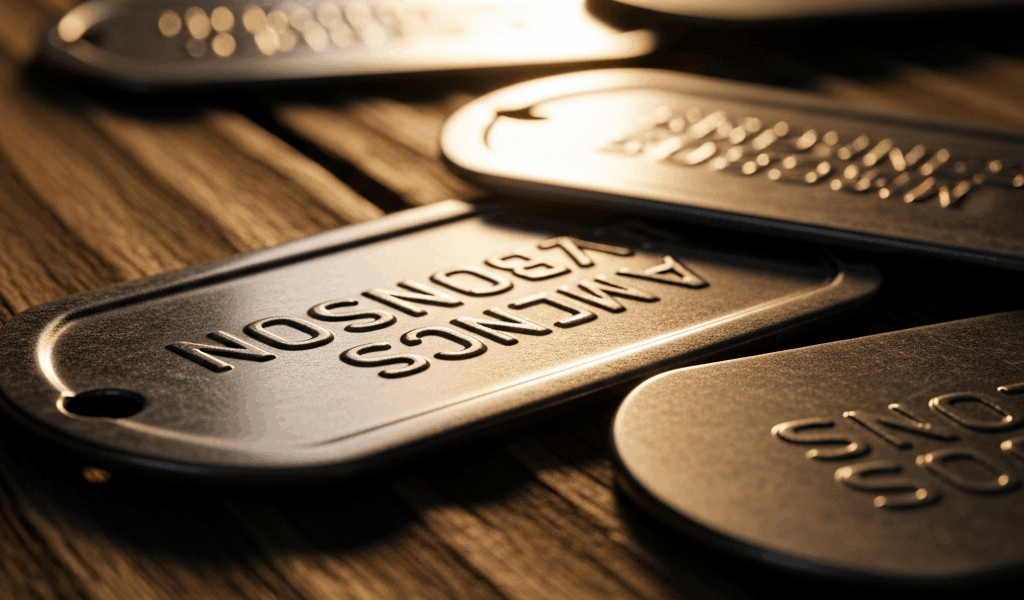
Photograph the tag at extreme side angles if you’re assessing one online. Shadows reveal depth better than direct overhead lighting. Authentic tags cast shadows that show real cavity walls. Shallow counterfeits cast almost no shadow at all.
Material and Weight Tell the Real Story
US military dog tags changed materials across eras, and counterfeiters rarely nail this detail. That’s what makes material examination so endearing to collectors like me.
WWII tags were aluminum — specifically, aluminum alloy with magnesium content. They’re non-magnetic and relatively light. A single WWII tag weighs approximately 3.5 to 4 grams. If you’re holding a tag and a magnet sticks to it, you have either a Korean War-era steel tag or a counterfeit. Most overseas counterfeits use mild steel because it’s cheaper and easier to stamp than aluminum.
The test is simple. Grab a refrigerator magnet. If it pulls to the tag, you’ve got a problem. Authentic WWII aluminum tags repel magnets entirely. Authentic Korean War steel tags attract them moderately. Modern tags post-1974 return to aluminum and are non-magnetic again.
Corrosion patterns also speak volumes. Real WWII tags develop specific oxidation. Aluminum oxidizes to a white or gray chalky surface — not rust-orange like iron. A tag claiming to be WWII that shows red-brown rust? Something’s wrong. New counterfeits won’t show authentic aging at all, but if someone’s tried to artificially age a fake, they often use vinegar or salt solutions that create uniform corrosion. Real aging from seven decades in wallets, uniform pockets, and occasionally soil is random. Uneven. Chaotic, even.
I learned this the hard way years back. Bought what I thought was a rare WWII tag set from an online seller for $220. The seller claimed it had belonged to a soldier from the 101st Airborne. When it arrived, the corrosion pattern was absolutely uniform — too perfect. That uniformity screamed artificial aging. Returned it immediately and got my money back, but the lesson stuck.
Another material red flag: the notch. Every authentic US military dog tag has a notch at one end. On WWII tags, it’s a rectangular cut about 1/4 inch wide and 1/8 inch deep. Counterfeits sometimes get the notch shape wrong or place it inconsistently. Some fakes skip the notch entirely — a bizarre oversight, but it happens. If you’re examining a tag from a specific era and the notch doesn’t match era standards, that’s a hard stop.
Serial Number Formats and Spacing Red Flags
Every era of US military dog tags followed strict serial numbering protocols. Fakes almost always violate these rules, and that’s where you catch them.
WWII tags (1941–1945): Serial numbers were typically 8 digits, stamped in a specific order following Army Serial Number conventions. Numbers were spaced evenly — usually 3-4 digits per line depending on name length. Counterfeits often center the numbers poorly or use spacing that doesn’t match the era. Look for inconsistent gaps between numerals.
Korean War tags (1950–1953): Serial formats shifted slightly. Numbers became more standardized in placement. Fakes from this era often use WWII spacing or modern spacing, which is instantly wrong to anyone who’s handled originals.
Vietnam-era tags (1965–1973): The format tightened further. Serial numbers followed a more rigid left-aligned pattern. See a Vietnam tag with scattered, center-aligned numerals? You’re likely looking at a counterfeit made from a WWII template.
Modern tags (1974–present): The SSN became standard. Before that, the Army Serial Number system applied. A tag claiming to be from 1968 but bearing an SSN? Impossible. That era switch is absolute.
Cross-reference any tag against military records if the name is legible. The National Archives can verify WWII service details. A tag claiming to belong to someone who doesn’t appear in service records is either a reproduction — which is fine, useful for reenactors — or a counterfeit sold as authentic. The second one is fraud.
Chain, Notch, and Attachment Hardware Clues
Separated by the tag itself, the chain and connector hardware are equally important. Don’t skip this part.
Real WWII tags came on a beaded chain, approximately 24 inches long, made from stainless steel or nickel-plated steel. The beads are small, uniform, and strung on a thinner wire than modern chains. Counterfeits frequently use modern ball-chain or thicker beaded chain that wasn’t in use during the WWII era. Examining a tag claiming to be 1943-original with modern hardware? The whole assembly is suspect.
The connector — the small fitting where the chain attaches to the notch — varied by decade. WWII used a simple open loop or split ring. Korean War introduced stamped connectors with more defined edges. Vietnam saw stamped connectors with specific thickness. Modern tags use molded plastic or stainless split-rings.
I once examined a tag that looked perfect. Crisp stamping. Correct material. Solid serial number. But the chain was clearly post-1980 ball-chain, far too modern for the “1944” date on the tag. The seller had combined an authentic tag with modern hardware. That’s mixing eras in a way that screams counterfeit assembly.
Look at the notch positioning too. On authentic WWII tags, the notch sits at the edge where the tag width narrows slightly. It’s designed so the connector won’t slip off. Counterfeits sometimes place the notch off-center or make it too shallow — something that never would have passed military QC.
When to Send It for Professional Grading
DIY authentication handles 95 percent of counterfeits. But some tags — particularly rare unit insignia or unclear provenance — deserve professional review.
Reputable authenticators like the American Military Institute and specialized militaria graders charge $25 to $75 per tag, typically with a 2-to-3-week turnaround. They document their findings with photographs and detailed reports, which protects you if you ever resell the tag.
Send it for grading if the tag bears rare or unverifiable unit markings. Or if the provenance story is unclear or suspiciously convenient. Or if the serial number doesn’t match any record you can find. Or if you’re considering a purchase above $200. Professional authentication becomes cost-justified at that price point.
For casual collections or tags under $50, the tests I’ve outlined should give you confidence. Trust your fingertips. Trust the magnet. Trust the photographic evidence of stamping depth. Counterfeits are getting better, but they’re not getting smarter about the fundamentals — and the fundamentals don’t lie.




Stay in the loop
Get the latest military memorabilia market updates delivered to your inbox.