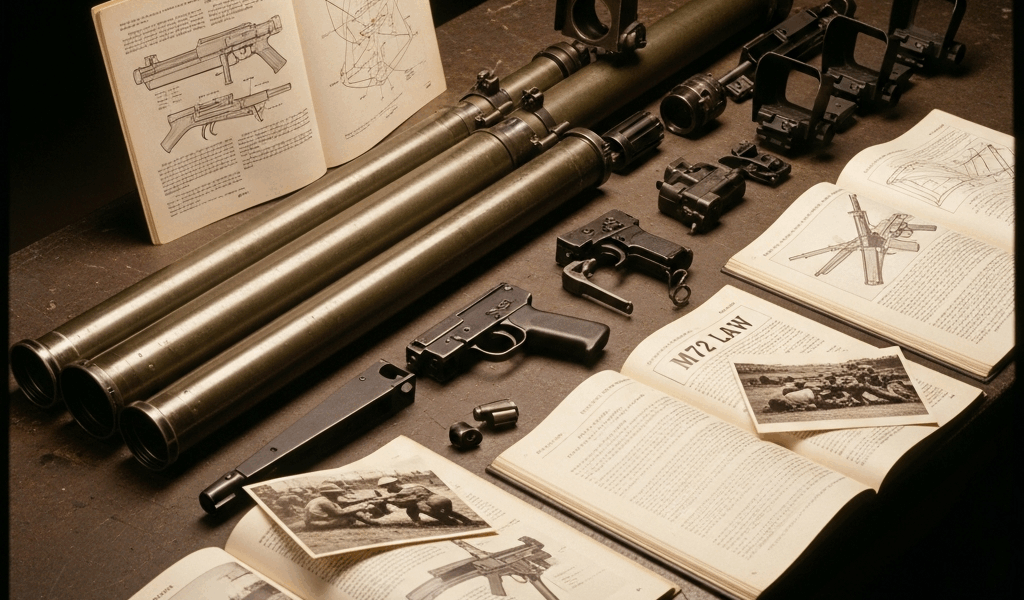
The M72 LAW — Why the Military Needed a Disposable Rocket Launcher
Cold War infantry tactics have gotten complicated with all the mythology flying around. As someone who spent years building a serious military hardware collection, I learned everything there is to know about the M72 LAW — and what I found completely upended how I’d been thinking about the whole era.
The M72 LAW wasn’t just another anti-tank weapon. It was a fundamental shift in how soldiers carried firepower. But what is the M72 LAW? In essence, it’s a single-shot, disposable rocket launcher that one soldier can carry, arm, and fire alone. But it’s much more than that.
The U.S. Army had a real problem by the early 1960s. The M20 Super Bazooka — standard anti-tank rocket launcher since World War II — weighed 14.5 pounds and needed two men to operate it. A gunner. A loader. In combat where seconds determined outcomes, that coordination requirement was a liability. Infantry commanders wanted lighter. They wanted something a single soldier could handle without specialized training spread across an entire rifle squad.
Korea had taught American planners something important. Future conflicts wouldn’t look like European tank battles — mountainous terrain swallowed heavy weapons teams whole, and infantry units needed anti-armor capability distributed throughout rifle squads rather than concentrated in dedicated teams waiting somewhere in the rear. You needed something different. Something immediately accessible.
Frustrated by the limitations of crew-served weapons in tight terrain, Army designers and contractors worked through iterative prototypes using standard production components — eventually landing on the M72 LAW, officially adopted in 1963. It weighed 5.2 pounds in launcher configuration. Telescoped from 24 inches closed to 34 inches extended for firing. The 66mm shaped charge warhead could punch through up to 10 inches of steel armor — enough for most Soviet light tanks and armored personnel carriers the Army anticipated facing.
What made the M72 revolutionary wasn’t the firepower-to-weight ratio alone. It was the disposable concept. Fire it, drop the tube, move on. No retrieval. No logistics chain hauling spent launchers backward through a combat zone. Each soldier could carry two or three of these single-shot weapons — instantly tripling available anti-armor firepower in a rifle squad. The tube cost roughly $300 at early 1960s production scale. Expensive, honestly, but manageable when spread across an entire force structure.
The psychological dimension mattered too. Every infantryman knew they had tank-killing capability riding in their rucksack. That confidence translated directly into tactical flexibility. That’s what makes the M72 endearing to us collectors — it wasn’t just hardware. It was doctrine made physical.
Variants from M72 to M72A9
Probably should have opened with this section, honestly. Because here’s where I made my first serious collector mistake — I assumed all M72s were essentially the same platform with cosmetic differences. Wrong. The weapon evolved continuously across nearly six decades, and those variants matter enormously for anyone serious about military hardware.
The original M72 appeared in 1963 — pull-ring ignition, basic sighting out to 300 meters, single-piece rocket design. Most originals were consumed in Vietnam or training exercises. Scarce now. Deactivated inert tubes, when they surface, command $800 to $1,400 depending on condition and paperwork trail.
The M72A1 entered production by 1966. Two-piece rocket design with refined aerodynamics — the warhead separated slightly from the rocket body during flight, which improved penetration performance in ways that looked minor on paper but proved significant downrange. The A1 carried American soldiers through most of Vietnam and into the 1970s.
Then came the M72A2 in the late 1970s — better weatherproofing, refined sighting systems, effective range pushed to 500 meters. Far more common in civilian collections because production ran longer and quantities were higher. Deactivated tubes typically run $400 to $700. This new improved design took off several years later and eventually evolved into the platform enthusiasts know and study today.
The M72A3 arrived in the 1980s. This is where things get genuinely interesting for collectors. Streaked by operational demands from Central America and the Middle East, the A3 featured a Prediction On Moving Target optical system — allowing gunners to engage moving vehicles more effectively than previous variants. The warhead received a slight redesign too. The A3 represents the bridge between Cold War and modern warfare, and production quantities were substantial enough that examples still surface regularly.
A4 and A5 variants followed through the 1990s and 2000s — better fuzing, improved environmental sealing, compatibility with modern load-bearing equipment. These variants honestly blur together without reference materials in front of me. The real leap came with the M72A7, introduced in 2008. Effective range extended to 600 meters. The sighting system switched to an open-frame design with Picatinny rail compatibility. Penetration capability dropped slightly to around 8 inches of steel but improved against reactive armor — a deliberate trade-off reflecting lessons from Iraq and Afghanistan.
The M72A8 introduced minor fuzing refinements. The current U.S. service variant — the M72A9, fielded in the late 2010s — features further optical improvements and enhanced reliability across extreme environmental conditions. Don’t expect to find A8 or A9 examples as deactivated collector pieces. They’re still actively deployed worldwide.
For collectors, the sweet spot sits with A2, A3, and A4 examples — enough historical distance to feel appropriately aged, common enough to actually locate, and representative of the platform’s tactical evolution during its peak relevance. Complete telescoping tubes in decent condition run $350 to $900 depending on variant and original markings.
Where the M72 Saw Combat
The M72 reached Vietnam almost immediately after adoption. American advisors were carrying them by 1964. When Operation Rolling Thunder escalated and the first official American ground combat units landed at Da Nang in 1965, the M72 was already standard equipment in every rifle squad.
The weapon proved devastating against Vietnamese fortifications — concrete bunkers, reinforced fighting positions, light armor that appeared increasingly in the later war years. A single soldier could destroy positions that previously required concentrated support fire. Machine gun fire couldn’t suppress reinforced concrete. A 66mm shaped charge absolutely could. That changed small unit tactics fundamentally.
Frustrated by real reliability issues and sighting problems, combat units fed constant feedback back through the chain — and engineers at production facilities in Connecticut and elsewhere incorporated fixes into successive variants within months. That’s the actual story behind M72 evolution. Not theoretical improvement committees. Direct combat feedback translated into hardware changes, sometimes remarkably quickly.
NATO adoption spread the M72 across the entire Cold War alliance structure. West Germany, Britain, France, Italy — all fielded variants extensively. West Germany produced domestic versions under license using local components. That’s why European military technical documentation on the M72 is so abundant — the weapon was genuinely everywhere across the alliance.
Soviet forces in Afghanistan encountered M72s when the CIA supplied them to mujahideen fighters — apparently without much concern about the optics. A detail that still fascinates me: launcher tubes abandoned in Afghan caves showed up in Soviet intelligence reports and eventually in military museums. Soviet engineers studied captured examples carefully. Their findings directly influenced armor design on subsequent Soviet vehicles. The M72 shaped enemy hardware design through its own capture.
British forces used M72s extensively during the Falklands War in 1982. Argentine forces carried them too — both sides, same weapon, same conflict. Central American wars throughout the 1980s saw M72s in Nicaragua, El Salvador, and Guatemala, fielded by government forces and American-backed militaries alike. The weapon transcended political alignment because its utility was simply undeniable.
When American forces returned to major ground combat after 2001, the M72 was still present — still recognizable to soldiers who’d trained on earlier variants. The Javelin missile system offered superior capabilities against heavy armor, sure. But the M72 remained ideal for lighter threats and situations demanding simple, disposable, reliable firepower without the complexity of guided systems. Some problems don’t require sophisticated solutions.
The cumulative result: more documented combat use than almost any other infantry weapon system across the latter half of the 20th century and into the 21st. That history makes the M72 genuinely significant — not just as hardware, but as a lens into how modern infantry warfare actually developed.
Collector Market for Inert M72 Items
Don’t make my mistake — legal considerations need to come first here, not last. I watched a collector friend absorb expensive consequences by not understanding federal regulations before purchasing. Deactivated M72 launcher tubes occupy interesting regulatory territory. They’re not classified as destructive devices under federal law if properly deactivated and marked. But that deactivation standard is strict.
A properly deactivated M72 tube must be permanently rendered incapable of firing — firing mechanism destroyed, not merely disabled. Welding, cutting, removal of essential components. Irreversible and documented. Removing ammunition isn’t sufficient. Jamming the mechanism isn’t sufficient. When purchasing a deactivated M72, you need documented proof of proper deactivation from a federally licensed firearms dealer or manufacturer. Full stop.
Prices reflect this reality — and vary dramatically because of it. A properly deactivated M72A2 tube with complete deactivation paperwork typically costs $450 to $700. The same tube without documentation? Legally questionable at minimum. Potentially thousands in federal penalties if authorities determine the deactivation doesn’t meet standards. While you won’t need to become a federal firearms attorney, you will need a handful of legitimate documents before any purchase makes sense.
Specialty military memorabilia dealers and auction houses focused on military hardware are your best sources — dealers who maintain proper Federal Firearms License documentation and specialize in deactivated weapons. First, you should verify licensing documentation independently — at least if you plan to display or transport these pieces across state lines. Online platforms exist, though state regulations vary enough that what’s straightforward in one state becomes complicated in another.
Documented provenance might be the best option, as M72 collecting requires clear paper trails. That is because the legal distinctions between properly and improperly deactivated tubes are not always visually obvious — and ignorance of the distinction doesn’t protect you from consequences. Expect to wait for the right examples from reputable sources rather than chasing convenient deals that skip the paperwork.



Stay in the loop
Get the latest military memorabilia market updates delivered to your inbox.