Why Bayonet Markings Matter More Than You Think
Bayonet collecting has gotten complicated with all the remarked junk and reproduction hardware flying around. I picked up what I thought was a solid M1 Garand bayonet at an estate sale for forty-five dollars. The seller had three of them sitting in a cardboard box — unlabeled, uncased, just rattling around together — and I grabbed the cleanest-looking one. Walked it to the counter without barely glancing at the blade ricasso. That was mistake number one.
Six months later, a collector friend told me that same bayonet with proper US arsenal markings and an authentic date code would fetch four hundred dollars or better. Mine had a faint maker’s stamp that didn’t match any known WWII-era manufacturer. Wall-hanger territory. A decent-looking wall-hanger, sure, but not a collectible.
That’s what makes bayonet markings so essential to us collectors. But what are WWII bayonet markings, exactly? In essence, they’re the stamped codes, symbols, and inspection cartouches that document a blade’s maker, acceptance date, and military chain of custody. But they’re much more than that — they’re the difference between a forty-five-dollar curiosity and a four-hundred-dollar investment piece. Unmarked or incorrectly marked bayonets flood the secondary market constantly. Not worthless. Just not serious money.
Think of this article as a field guide. Read it before you buy. Bring it to the flea market. Use it on pieces you already own. So, without further ado, let’s dive in.
US Bayonet Markings — M1905 and M1 Garand Era
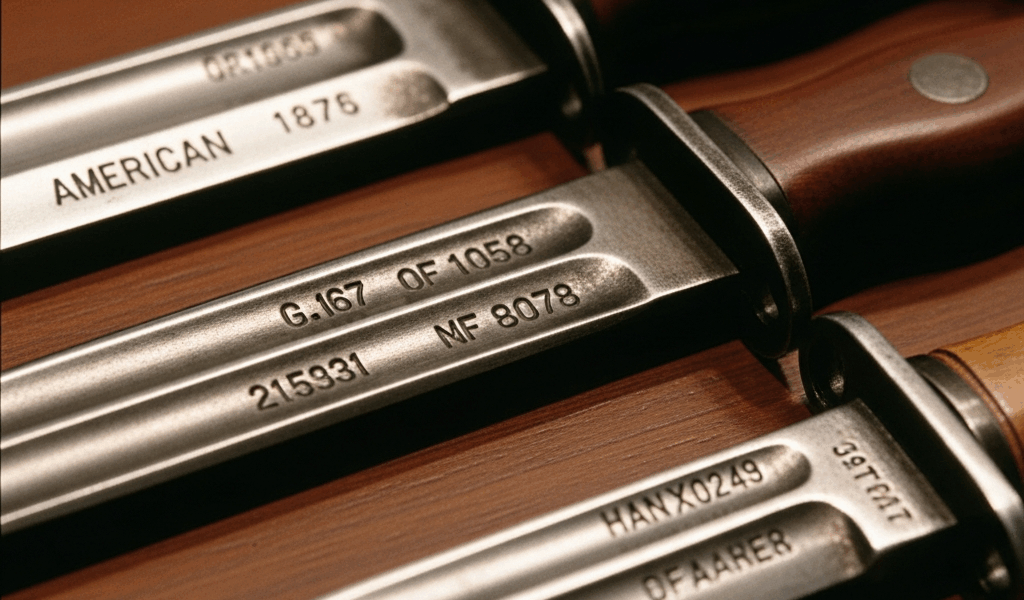
American bayonets from the WWI through early WWII period carry a specific marking vocabulary. Start with the ricasso — the flat, unsharpened section where the blade meets the hilt. Manufacturers stamped their initials there. Every time. That’s your first stop.
Manufacturer Stamps and Their Locations
The major US makers were Remington (UFH inside a circle), Sears Roebuck (SA), and PAL — Plumb American Limited, a Pennsylvania outfit. You’ll also spot OL for Oklahoma Leather on scabbard stamps. These abbreviations sit on the ricasso, sometimes with a date code stamped immediately below or just to the side. Stamps should be clear and evenly struck. Not fuzzy. Not over-deep. Those are warning signs right there.
On the pommel — the bottom of the grip where your pinky rests — you may find additional markings. US Army inspection cartouches show up here: an inspector’s initials inside a rectangular box. They look deliberate. Controlled. Faked inspection marks tend to have inconsistent depth or irregular outlines that feel slightly wrong the moment you look closely.
Date Codes and Inspection Marks
Early M1905 bayonets show full maker names: “Remington Arms Co.” or “Sears Roebuck & Co.” By the 1930s and into full WWII production, manufacturers switched to three-letter codes paired with a two-digit year. So “UFH 41” means Remington, manufactured in 1941. Simple system once you know it.
I’m apparently a tactile examiner, and handling forty-plus M1 bayonets in person works for me while photographs alone never quite capture what I need. Authentic stamps share a similar hand-struck quality — slightly irregular, but consistent in execution across multiple pieces. Remarked bayonets often show stamps that look photocopied or laser-engraved. Too uniform. Too crisp. Too perfect. Real military stamps weren’t applied by machines chasing tolerances.
Blade finish matters here too. Original parkerized gray should show wear patterns consistent with age — deep scratches near the guard, spotting and oxidation around the ricasso. Polished or reblued blades — the shiny black ones — deserve extra scrutiny. Refinishing and remarking tend to happen together. Don’t make my mistake of assuming clean means authentic.
German WWII Bayonet Maker Codes and Proof Marks
German bayonets demand a different reading strategy entirely. Wehrmacht acceptance stamps are immediately recognizable once you’ve seen a few genuine examples, but the maker codes require familiarity with a completely separate system. Plan to spend some time with reference material before shopping.
Pre-War Full-Name Stamps vs. Three-Letter Codes
Before 1940, German manufacturers stamped their full names on the ricasso. “Weyersberg, Kirschbaum & Cie” or simply “Solingen.” After 1940, wartime production pressures pushed the switch to three-letter abbreviations. Codes like WKC, AXE, ZWS, and ZEH replaced full names practically overnight. Knowing this timeline helps you spot remarked pieces immediately — an M98/05 bayonet with a three-letter code is supposedly post-1940 manufacture, which is historically impossible for that model. That’s a red flag you can’t ignore.
Waffenampt Acceptance Marks
Probably should have opened with this section, honestly. German markings are the most commonly faked category I’ve encountered across fifteen years of buying and selling. Scammers know collectors specifically hunt for clean Waffenampt stamps, so reproduction bayonets flood eBay and overseas auction sites carrying laser-engraved eagles that look almost right until you’ve held a genuine one.
The Wehrmacht’s official acceptance stamp is an eagle perched atop a number — three or four digits corresponding to the arsenal or manufacturer. The eagle’s face should be detailed and properly proportioned. Never cartoonish. Never blocky. These stamps appear on the ricasso or blade spine. A correct Waffenampt mark on an otherwise common bayonet can jump its value significantly. A fake one can cost you serious money.
Scabbard Markings and Blade Finish
Don’t neglect the scabbard. German leather scabbards carry their own inspection stamps and maker codes. The steel chape — that’s the metal tip at the bottom — often bears the same maker’s mark as the blade itself. If blade and scabbard markings don’t align logically, different makers or wildly separated date codes, you’re looking at either a mixed set or a remarked piece. Original matched sets stayed together through Nazi Germany’s military supply chain. Mismatched components suggest modern assembly from salvage parts. Collectors call these “Franken-bayonets.” Not a compliment.
Blade finish on authentic German pieces shows blue-gray parkerizing similar to US production, but German manufacturing sometimes left a slight polish before parkerizing — creating a micro-texture you can actually feel with your fingertip. Run your thumb along the ricasso of a genuine piece and you’ll detect it. Reblued blades flatten that texture completely. Your thumb knows before your eyes do.
Japanese Type 30 Bayonet Arsenal Markings Decoded
Japanese bayonet markings follow their own complex logic — and they’re less commonly understood in the Western collector market. That creates both opportunity and real risk. The arsenal marks are your gateway to dating and valuing these pieces accurately.
Chrysanthemum and Anchor Symbols
The chrysanthemum — a circular flower with petals spreading outward — indicates imperial Japanese military issue. Different variants correspond to specific arsenals. Kokura Arsenal, Nagoya Arsenal, and Tokyo Arsenal each used distinctive stamps. The chrysanthemum may be coupled with an anchor symbol or other geometric marks depending on origin. Learning to distinguish between these variants requires dedicated reference material. Dirk Watts’ “Japanese Bayonets” provides detailed photographic comparison and is worth every dollar of the $65 or so it costs used.
Mon Symbol Variations and Date of Manufacture
The mon — Japan’s version of a family crest or seal symbol — appears on both blade and scabbard. The specific variant tells you which production year or batch you’re examining. Early-war Type 30 bayonets show cleaner, more detailed mon stamps. Late-war production, pressured by Allied bombing campaigns and material shortages, used cruder dies. The mon becomes shallower. Less refined. A Type 30 with a pristine, deeply-struck mon is likely earlier manufacture. Shallow, worn-looking stamps suggest 1943-1945 production — and usually lower values too.
Handle Material and Construction Changes
Handle construction shifted visibly during the war years. Early Type 30 bayonets have wood grips wrapped in metal bands. As the war progressed and raw materials tightened, Japanese manufacturers moved to cast metal grips and composite materials. By 1944-45, many pieces show crude metal handles or visibly degraded wood. A Type 30 with a pristine wooden grip deserves careful examination — either it’s an early piece that survived without hard use, or it’s a postwar rebuild wearing original-looking components.
The scabbard tells this same story independently. Leather scabbards gave way to metal-reinforced designs and eventually fabric-wrapped versions. Dating the scabbard separately from the blade helps verify whether you’re holding a genuine matched original or a mixed set assembled decades after the war ended.
How to Spot a Remarked or Fake Bayonet
Armed with marking knowledge, you still need practical detection methods. Here are the concrete red flags I check before committing to any purchase — including that forty-five-dollar estate sale lesson I apparently needed to learn the hard way.
Crisp Stamps and Font Inconsistency
Authentic military stamps, hand-struck across millions of pieces over years of wartime production, show natural variation. Some strikes are deeper. Others shallower. Font weight varies slightly from piece to piece. When you examine a bayonet with stamps that look perfectly uniform — every letter exactly the same depth, every curve identical — you’re looking at either modern laser engraving or a machine-applied die stamp. Both are anachronistic for WWII production. Real hand-struck stamps are subtly imperfect. That imperfection is the authentication.
Mismatched Serial Ranges
A blade carrying a date code of “41” paired with a scabbard showing “38” — ask hard questions before your wallet opens. Military procurement systems weren’t chaotic enough to allow that kind of mismatch in original issue equipment. Mismatched dates suggest a modern collector or dealer assembled the set from separate pieces. Not necessarily disqualifying, but definitely not authentic. Similarly, conflicting maker stamps — a Remington blade with a Sears scabbard — should trigger immediate skepticism.
Incorrect Font Styles for the Period
German Waffenampt eagles from 1942 look different from those used in 1944. This isn’t subtle once you’ve studied the reference material. Faked eagles often lack the specific anatomical proportions of genuine dies — the beak angle is wrong, wing details are simplified, the number below sits at an incorrect distance. After examining ten or fifteen authentic pieces in high-resolution photographs, you develop an eye for these discrepancies faster than you’d expect.
Tools and Verification Resources
While you won’t need a laboratory, you will need a handful of basic tools. A 10x magnifying loupe and a UV light are non-negotiable for any serious viewing. The loupe reveals die characteristics and stamp depth patterns completely invisible to the naked eye. UV light exposes rebluing and reparking — modern finishes react differently to ultraviolet than original parkerizing does. A $25 loupe from Amazon has saved me from more than one expensive mistake.
Reference books might be the best option, as bayonet authentication requires verified visual comparisons. That is because no description fully replaces seeing authentic stamps photographed against fakes. Get copies of Dirk Watts’ “German Bayonets” and James Farley’s “U.S. Military Bayonets and Scabbards.” These set the standard. When you encounter a marking you don’t recognize, cross-reference it against verified examples before assuming it’s legitimate. If it’s not in Farley or Watts, it may simply not exist.
First, you should use your hands — at least if you want the full picture. Feel the weight. Test the blade flex. Tap the ricasso lightly and listen. Authentic bayonets have consistent materials and construction that reveal themselves physically. Remarked pieces often feel slightly wrong before you can articulate why — incorrect weight distribution, different metal composition, scabbard fit that’s just loose enough to notice. Your hands pick up what your eyes miss. Trust that feeling, then go verify it with your loupe.
Bayonet collecting rewards patience and skepticism in equal measure. The markings tell the story. Your job is learning to read them accurately before the money changes hands.


Stay in the loop
Get the latest military memorabilia market updates delivered to your inbox.