What Makes the M-1943 Field Jacket Distinct
WWII militaria collecting has gotten complicated with all the reproductions and misinformation flying around. As someone who’s spent years haunting swap meets, estate sales, and online auctions hunting American military kit, I learned everything there is to know about separating authentic M-1943 field jackets from the fakes that keep getting better. Today, I will share it all with you.
But what is the M-1943, exactly? In essence, it’s the standard-issue field jacket American soldiers wore through the latter half of World War II. But it’s much more than that — it’s a design pivot point sitting between two distinct eras of military outerwear. The earlier M-1941 used a full-length front zipper. The M-1943 ditched that entirely. Buttons instead. Four large patch pockets remained — two chest, two hip — but the drawstring waist got metal eyelets, not a simple hemmed cord channel. The collar sits notched and relatively flat.
The real identifier, though? The button-in wool liner system. That liner isn’t sewn in place. It attaches via cloth tabs and buttons running along the inside shoulders and waist. That single detail matters enormously for both authentication and value. Don’t overlook it.
The shell itself is heavy sateen-weave cotton — olive drab, typically logged as OD-7 or OD-3 depending on production year. Pick up a reproduction and your hand registers the difference immediately. Authentic shells run roughly 1.5 to 1.7 pounds. Anything noticeably lighter should stop you cold.
How to Read the Contract Tag
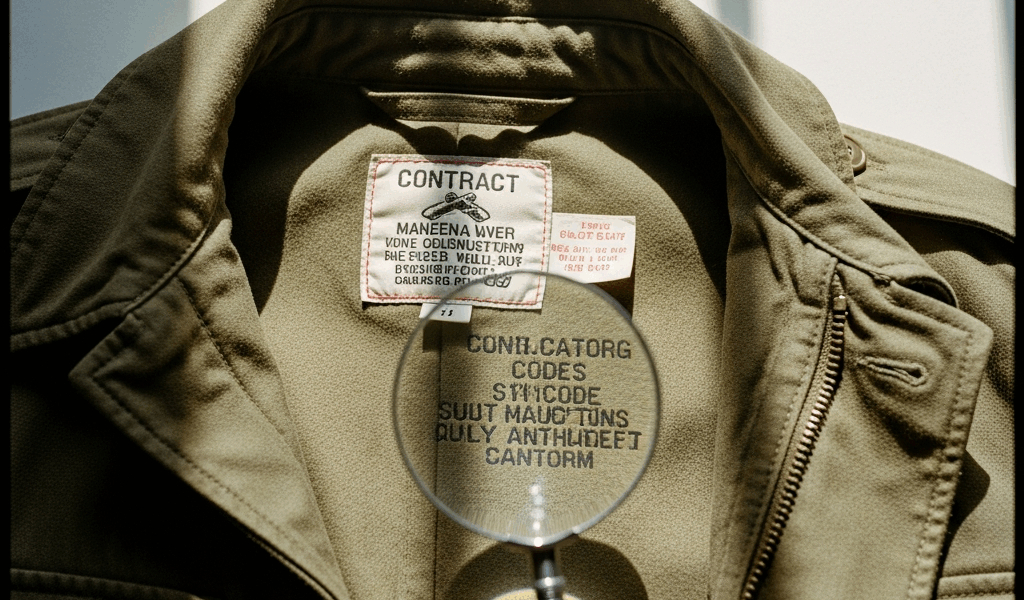
Probably should have opened with this section, honestly. I spent three hours at a flea market in rural Ohio last summer watching three different collectors walk past authentic jackets because they had no idea where the tag lived or what it said. Interior left side. Beneath the left chest pocket. Sewn directly to the shell fabric. That’s where you look — every single time.
An authentic WWII-era M-1943 tag contains specific fields:
- Contract number (format: typically “QM-” followed by numerals, like QM-24-12-N)
- Size designation (usually “Small Regular,” “Medium Regular,” “Large Regular” — never just a number)
- Manufacturer name (Hercules Garment Co., Quartermaster Depot, Alamo Manufacturing, and others)
- Year of manufacture (printed or stamped, 1943–1945 for genuine examples)
- Sometimes, a lot or batch number
Legitimate manufacturers you’ll encounter: Hercules Garment Co., Quartermaster Contract Division, Alamo Manufacturing, Lawson Manufacturing, Crescent Manufacturing. These names show up consistently in period procurement documents and museum collections. A tag reading “Made in Taiwan” or showing any date past 1945 — without obvious re-labeling — means you’re holding either a reproduction or a later-issue piece. Walk away or adjust your offer accordingly.
The tag material itself tells you things. Authentic tags use cotton twill backing with printed text. Not embroidered. After 70-plus years, that printing fades unevenly — sweat, field conditions, age working on the fabric together. I’m apparently sensitive to this detail and uneven fading works for me as a confidence signal while uniform, crisp lettering never does. One reproduction I examined at a militaria show in Gettysburg had perfectly legible text. Too perfect. Real tags blur. They ghost. They earn their age.
Missing tags don’t automatically signal fake. Soldiers pulled tags to stop chafing during long marches — completely documented behavior. But a missing tag makes provenance nearly impossible to establish and drops value from the $600-plus range down to $200–300 for an otherwise solid example. Factor that math into every purchase.
Construction Details That Confirm Authenticity
Feel the seams. Run your fingers along the interior. Authentic M-1943 examples hold roughly 10–12 stitches per inch on main seams. Reproductions frequently cut this to 6–8 stitches per inch. The difference is tangible — tighter feels more substantial, almost rigid by comparison.
Examine every button. WWII-era field jackets used four-hole composition buttons blended from cellulose or Bakelite materials. Hold one in your palm for five seconds — it warms slightly. That’s the material composition doing its thing. Later post-war plastic buttons stay noticeably colder and feel smoother under a fingernail drag. Flip each button over. Authentic versions show slightly rough or dimpled texture from casting. The shank — that post underneath — should look molded, not machined to uniform perfection. Many reproductions use modern plastic buttons that feel completely, obviously wrong the moment you touch them.
The pocket flaps deserve a dedicated look. M-1943 flaps are single-layer construction with a finished edge — no separate lining piece stitched and folded over. Buttonholes on these flaps should appear cleanly machine-stitched or hand-worked with consistent tension. Sloppy buttonholes with loose threads pulling away from the edge? Reproduction work, almost certainly.
Some later production runs added a zipper. If your jacket has one, look for manufacturer stamps. Talon and Scovill were the wartime suppliers. A YKK zipper is an immediate red flag — that brand didn’t dominate until decades later. Wartime zippers feel stiff and mechanical. Less refined. Modern zippers glide. That contrast is obvious once you’ve felt both.
One test I use constantly: check the hem allowance at the jacket’s bottom interior. Authentic examples show approximately one inch of hem fabric, sometimes more. Reproductions skimp here — narrow, sloppy hems that look rushed and obviously modern. Don’t make my mistake of skipping this check when the rest of a jacket looks promising.
Common Fakes and Reproduction Red Flags
The reproduction market is large and getting better. That’s the bad news. The good news? They still miss critical details — sometimes embarrassingly obvious ones.
Shade catches fakes fastest. Authentic OD-7 carries a slightly greenish cast with visible brown undertones running through the weave. Many reproductions nail a flat, uniform olive tone that reads slightly too yellow under natural light. Hold an authentic and a reproduction side-by-side outside on an overcast day. The difference jumps out immediately — no magnification needed.
Pocket placement is measurable, which makes it useful. On a correctly constructed M-1943, chest pockets measure roughly 5.5 inches across and sit approximately 4 inches down from the shoulder seam. Hip pockets land about 9 inches from center front. Reproduction makers frequently eyeball this and miss. Pockets that sit noticeably smaller or lower on the body are a serious warning sign worth measuring before you hand over money.
The drawstring system reveals sloppiness regularly. Authentic examples use simple cotton cord or webbing threaded through small, cleanly punched metal eyelets. Reproductions often substitute plastic tubing, oversized modern cord, or install eyelets that are visibly larger and seated incorrectly. This is a thirty-second check that eliminates a lot of bad purchases.
Button attachment method matters too. Period jackets have buttons sewn with wire shanks using heavy thread — the shaft sometimes shows marks from the wrapping. Modern reproductions attach plastic-backed buttons with barely adequate thread or, worse, adhesive backing. Pull gently on a button. You’ll feel immediately whether it’s going anywhere.
What Condition and Completeness Mean for Value
A shell-only M-1943 in fair condition — light wear, no rips, fading present — runs $300–450 right now. Good condition bumps that to $500–700. Excellent examples with minimal wear hit $800 and above. “Excellent” here means no holes, intact buttons, a readable tag, no staining that won’t respond to careful cleaning.
Add an original button-in wool liner matching the contract year and prices jump 50–75 percent immediately. A good jacket paired with its original liner becomes a $1,000–1,200 piece. Excellent condition matched sets? $1,500–2,000. These numbers hold across most major collector markets — shows, online platforms, dealer catalogs.
That’s what makes matched contract numbers endearing to us collectors. If your jacket tags QM-24-12-N and the liner reads QM-25-08-K, they were sourced separately at some point. Pair value drops. Collectors pay genuine premiums for matched sets because they’re increasingly rare — field use scattered these components across decades.
Rips, stains, or missing buttons drop value roughly 30–40 percent per issue. A $700 jacket with one torn seam becomes a $450 jacket. This compounds fast. Factor repair costs into your purchase math — quality tailoring to restore seams at a shop familiar with vintage military garments runs $75–150 typically. So, without further ado, measure twice before committing: the jacket’s condition, the liner match, the tag legibility, the construction details. Get all of those right and you’ll buy confidently. Miss one and you’ll learn an expensive lesson.



Stay in the loop
Get the latest military memorabilia market updates delivered to your inbox.