What Made WWI Puttees Different
As someone who spent three years collecting and handling authentic WWI British officer kit, I learned everything there is to know about puttees — honestly, they might be the most underappreciated authentication challenge in military collecting. These wrapped leg coverings seem simple at first glance. Just cloth wound diagonally around the calf and shin. But they’re actually a window into how the British Army evolved between the Boer War and the Western Front.
The puttee itself wasn’t invented by the British. Indian troops wrapped their legs this way for centuries before anyone in London took notice. When British officers returned from South Africa around 1900, they brought the idea home, and the War Office standardized it. By 1915, every officer and many enlisted men wore them — that’s what makes puttees endearing to military historians. The design stayed remarkably consistent through WWI, which is exactly why counterfeits exist today.
Here’s the thing though: puttees were disposable. They were issued in quantity, worn until they fell apart, and discarded without ceremony. A soldier might go through six pairs in a year of trench warfare. Mud, water, boot friction, constant rewrapping — these things destroyed them. Finding an intact pair from 1916 is like finding an unworn pair of socks from your grandfather’s childhood. They shouldn’t exist, yet someone’s selling them. That rarity created demand. And demand created reproductions.
Reproductions range from honest modern recreations to deliberate fakes designed to deceive. A collector in London told me she bought what she thought was an original 1917 pair for £85. The seller claimed it came from an estate lot in Sussex. She brought it to me, skeptical. Under magnification, the weave pattern was too uniform — modern machinery had made it. She’d been burned.
Understanding why WWI puttees were constructed the way they were — and how mass wartime production actually worked — is your first defense against counterfeits. The British didn’t have time for fancy stitching by 1916. They needed durability. Speed. Consistency within chaos. Knowing this helps you spot when someone’s tried too hard to make something “authentic.”
Check the Weave Pattern First
The diagonal weave is your primary authentication tool. This is where almost every fake fails.
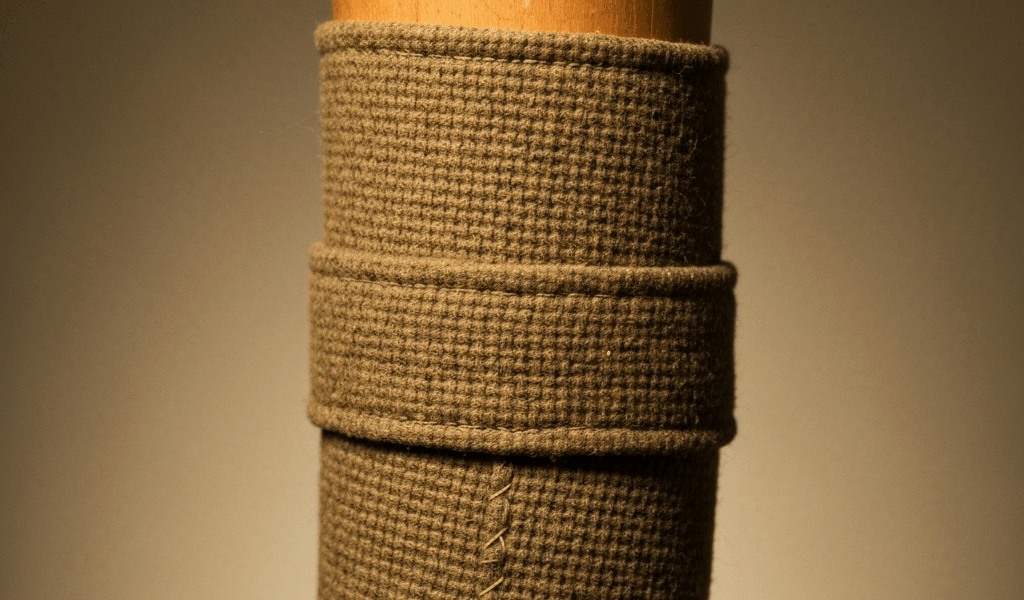
Real WWI puttees show a hand-loom or early power-loom weave that’s diagonal at roughly 45 degrees. Use a 10x magnifier if you can get one — good light matters. The pattern should look almost hypnotic but slightly imperfect. Individual threads vary in tension. The diagonal isn’t mathematically perfect. You’ll see subtle irregularities where the weaver adjusted tension or the loom had a minor hiccup. This happened thousands of times during manufacturing, shift after shift.
Modern counterfeits, especially those made in the last 20 years, use contemporary looms programmed for uniformity. The weave pattern is too regular. Too perfect. The diagonal line doesn’t waver even slightly. Individual thread crossings repeat like wallpaper. When you see that kind of mechanical precision in fabric from 1915-1918, you’re looking at a fake. Full stop.
Examine at least three different sections. Look at the seam edge, the middle of the fabric, and near the binding tape. Real puttees show slight variations across these areas because they were made in batches by different workers on different days. I once held an original pair from the 56th (London) Division and photographed the weave under a 15x loupe. You could literally see where one shift worker had handed off to another — a microscopic change in thread tension at roughly 18-inch intervals along the length. That’s the detail most fakers miss.
If you’re buying online, ask the seller for macro photography of the weave. Honest sellers will provide it without hesitation. Fakers won’t. They’ll say the photos aren’t clear enough, or they’ll offer only pictures from 12 inches away. Don’t accept that excuse. The weave pattern is non-negotiable evidence.
The fabric itself should be linen-cotton blend or pure cotton. WWI British puttees were never pure wool, despite what some dealers claim trying to justify higher prices. Probably should have opened with this section, honestly, because I’ve seen buyers reject genuine pieces because they expected wool. The blend gave puttees their slight stiffness when dry and their durability when soaked in trench mud. A genuine pair from 1917 should have a specific hand — a texture that feels worked-in but structured. It shouldn’t feel like modern cotton drill fresh off a department store bolt.
Fabric Dye and Color Fading Tell the Truth
Dye fading patterns are almost like fingerprints. They reveal how a puttee actually lived.
Authentic WWI puttees show selective, non-uniform fading. The areas that received the most friction and exposure — the outer face of the wrap, where the shin bent — are often 15-25% lighter than the inner protected layers. This isn’t random or accidental. It’s mechanical. Boot friction lightens color. Mud exposure lightens color. Direct sunlight lightens color when the puttee dried. Protected edges, especially where the puttee overlapped itself or sat under a boot-top, they stay darker.
Counterfeits almost always fail this test. Fakers apply artificial aging by soaking, sun-bleaching, or chemical treatment. The result looks uniformly aged, like someone dipped the entire puttee in weak tea. Or they don’t age it at all — you get a puttee that’s too bright, obviously never worn. Real age is uneven. Real age tells a story about where that puttee spent its time.
The khaki dye itself matters more than most people realize. British War Office khaki from 1915-1918 had a slightly greenish undertone because of the dyes available then. Later khaki (1920s onward) shifted warmer, more tan. This happened because dye suppliers changed; natural indigo precursors became scarce during the war. If you’re looking at a puttee that claims to be 1916 issue but has that warm, golden-tan color you see in 1940s drill, something’s wrong with the provenance.
Look for color variation between paired puttees, too. Authentic pairs often don’t match perfectly because they might come from different production runs. One might be slightly greener, the other slightly browner. This asymmetry was completely normal. Modern counterfeits are often too matched — manufactured in the same batch, dyed in the same vat, aged in the same process. Real military issue was messier, more chaotic.
I examined a pair supposedly from an officer’s estate sale in Hampshire last year. Both puttees were identical in color — too identical. Same shade of khaki, same fading pattern, same wear marks in the same places on each leg. Original pairs develop unique patinas over different lives. These looked factory-distressed, aged on purpose. Turned out they were 2008 reproductions, sold as genuine by someone who didn’t know the difference between wear and artificial weathering.
Stitching Seams and Thread Integrity
The stitching is technical but learnable. You don’t need to be an expert seamstress to spot problems.
Authentic WWI puttees have one lengthwise seam running up the back. This seam could be hand-stitched or machine-stitched depending on the factory and date. Hand-stitched seams — common in officer-pattern puttees made by contractors like Gieves or Hawkes — show irregular stitch length. Usually 4-7mm per stitch, but varying. The tension isn’t perfectly even because no human hand moves perfectly consistently. The thread makes tiny loops on the reverse side where the needle entered at slightly different angles on each pass.
Machine-stitched seams from WWI factories show metronomic precision — 6mm stitches, perfect tension, absolutely regular. But here’s the key that most people miss: the thread itself looks different. Original thread was cotton, often undyed or dyed to match the fabric. It deteriorates predictably. After 100 years, WWI thread becomes fragile. It breaks if you pull it. Sometimes the thread oxidizes and darkens independently of the fabric around it, turning almost brown while the puttee stays khaki.
Modern reproductions use polyester thread or modern cotton with synthetic coatings. This thread is still strong after a century because it was made a century later. When you see a seam with 2024-strength thread in a puttee that’s supposedly from 1917, you’re looking at a fake. The longevity doesn’t match the age.
Feel the seam with your fingertip. Genuine WWI puttees have slightly rough, uneven seams because finishing wasn’t perfected the way modern sewing is. Press your fingernail along the seam on the inside. You should feel micro-variations, tiny imperfections. Modern seams are glassy-smooth, almost slippery.
The binding tape along the edges — where the ends of the puttee are finished — offers another data point. Original binding was usually 5/8-inch cotton tape, stitched with thread that matched or contrasted slightly. Modern reproductions often use bias tape or pre-made binding that looks too uniform, too perfect. Original binding sometimes has ink markings or starch stiffening that’s flaked away after decades. That brittleness is authentic.
Sizing and Marking Standards
British War Office puttees carried specific markings. Knowing what’s authentic saves you from overstretched fakes or deliberate forgeries.
Officer puttees were typically marked inside the binding tape with an inked stamp. You’re looking for the manufacturer’s name (Gieves, Hawkes, Burberry, or a contract manufacturer), sometimes a size, and occasionally a broad arrow — the Crown property mark. Enlisted men’s puttees had fewer markings, sometimes just the broad arrow indicating government ownership.
Sizing was straightforward. Puttees came in three basic lengths: 75 inches, 80 inches, and 85 inches. An officer of average height (5’8″ to 5’10”) used the 80-inch length. Taller men or men with muscular calves used 85 inches. These measurements are printed clearly on authentic examples. If the marking is smudged, faded, or barely legible, that’s normal. If the marking is perfectly crisp and modern-looking, that’s a red flag indicating a recent addition.
Counterfeits sometimes over-weather their markings. The ink is so faded it’s invisible, supposedly because of 100 years of wear. But puttees were stored in barracks bags and footlockers — protected from light and moisture. Markings should survive, albeit faded. Complete absence of any marking on an officer puttee claiming to be original should make you skeptical.
Watch for anachronistic markings carefully. If you see a stamp that says “Made in England” in a style that looks 1950s-modern, that puttee is later than WWI. Wartime markings were utilitarian — stamped or written quickly by overworked ordnance clerks. Post-war markings got fancier and more decorative as peacetime manufacturing standards changed.
I once bid on a lot of puttees at an auction in Bath. One pair had what looked like a perfectly preserved Gieves stamp. Too perfect. I asked the auctioneer if I could examine them before the sale. Under the loupe, the stamp had been applied to the fabric after it was already aged — the ink sat on top of the worn surface rather than soaking into the weave the way original ink does. Someone had forged the provenance stamp on a modern reproduction. I dropped out of the bidding immediately.
Buy from reputable dealers. Examine photos thoroughly — ask for close-ups. Ask hard questions about provenance. Don’t make my mistake of being too trusting early on. And remember: finding an absolutely pristine pair of WWI puttees should make you skeptical, not excited. They were worn. They aged. They should show it.


Stay in the loop
Get the latest military memorabilia market updates delivered to your inbox.