Why Japanese Sword Reproductions Matter to Collectors
Japanese military swords how to spot reproductions—that exact search phrase tells me something important. The market for authentic katana, wakizashi, and tantō blades has gotten genuinely out of hand in the past decade. Military history enthusiasts and martial artists have driven prices skyward. When a legitimate Showa-era officer’s sword can fetch $3,000 to $8,000, you’ve created the perfect environment for skilled counterfeiters to move product.
I’ve spent the last three years helping friends and fellow collectors navigate this minefield. What shocked me most wasn’t the volume of fakes—it was how convincing some of them look at first glance. A well-executed reproduction katana might pass casual inspection. The tang can look aged. The patina might seem authentic. The signature appears appropriately worn.
Then you actually inspect it properly, and everything falls apart.
After 2015, everything accelerated. Cheaper manufacturing in Southeast Asia improved dramatically. Japanese sword-making knowledge leaked into online tutorials. International shipping became reliable enough for bulk imports. You want to know the real number? Estimates suggest roughly 60-70% of swords currently listed on major auction sites are either reproductions or heavily modified pieces. That’s not fear-mongering. That’s what casual buyers face when they’re shopping.
Steel Quality and Patina Red Flags
Steel quality separates authentic Japanese military swords from reproductions faster than anything else. You don’t need a metallurgist. You need observation skills and knowledge of what genuine aging actually looks like.
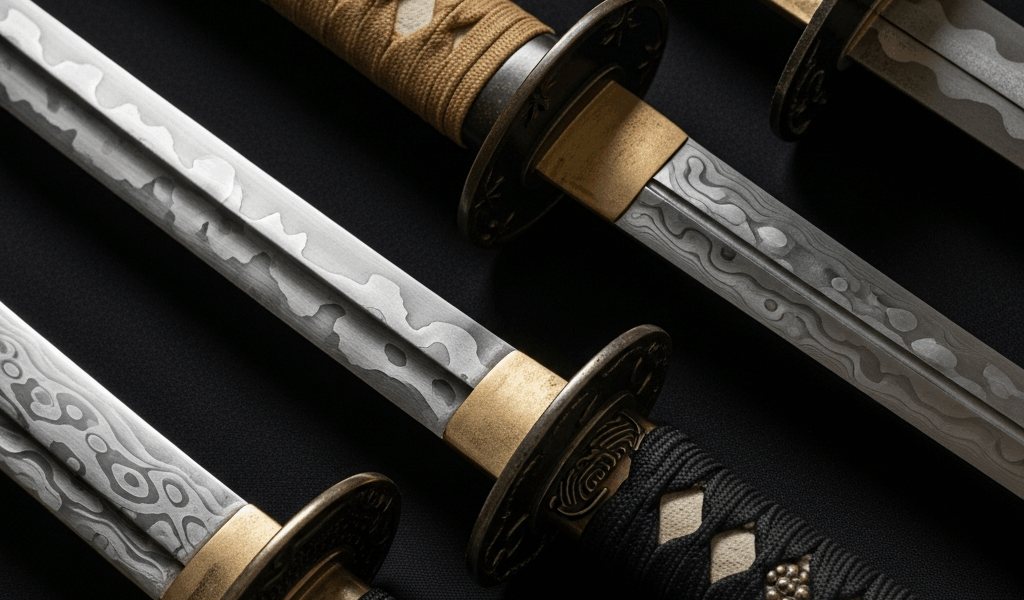
Authentic nihontō steel—particularly pieces from the 1930s-1945 Imperial Japanese military period—develops a very specific patina. The rust pattern isn’t uniform. High-carbon folded steel creates microscopically distinct oxidation zones. Real patina has depth. When light hits an authentic blade at an angle, you see layering. The surface isn’t uniformly brown or reddish. It looks like geological strata compressed onto metal.
Reproductions typically fail here spectacularly. Manufacturers apply chemical treatments to create uniform rust coloring. They aim for “aged” appearance through surface-level oxidation. I examined a $400 reproduction katana last year—the seller claimed it was a 1943 officer’s sword—and the patina looked like someone had spray-painted the blade with a rusty brown coating. Zero depth. Zero variation. No character at all.
Weight-to-length ratios matter more than most collectors realize. A genuine Japanese military katana typically weighs between 1,200 to 1,400 grams and measures 66 to 73 centimeters in blade length. If you’re holding something that weighs 950 grams in the same length, the steel composition is wrong. Reproductions often cut corners by using lower-grade steel that requires thicker blade stock to achieve adequate strength. This changes the balance point. Authentic blades feel alive in your hands — like they know what they’re supposed to do. Reproductions feel dead.
Surface finish consistency reveals everything. Run your fingers along the blade spine—not the edge, the spine. Authentic old steel has microscopic variations. Small pits. Minor surface irregularities accumulated over decades. A sword that feels polished smooth across the entire spine probably isn’t old. The Japanese didn’t finish their military blades with modern buffing techniques. Hand-polishing left subtle directional marks that time hasn’t erased.
Examining the Tang and Maker’s Signature
The nakago—the tang, the unseen part of the blade that sits inside the handle—is where reproductions betray themselves most reliably. Probably should have opened with this section, honestly. The tang is your best authentication tool because so few people actually look at it closely.
Start with the signature. Authentic Japanese swordmakers signed their work with a specific technique: they used a tool to cut characters (usually the maker’s name and sometimes the manufacturing date) into the steel before heat treatment. The signature isn’t painted. It’s not etched after the blade hardened. The characters were created during the forging process, which means genuine signatures have edges that are slightly rounded from the subsequent hardening and tempering.
Reproductions typically etch or stamp signatures after the fact. This creates sharp, clean edges on the characters. If you can catch light along the signature and see the edges are crisp and uniform, you’re looking at a fake. Real signatures look slightly worn, with edges that have rounded from the hardening process and decades of handling.
Common names to watch for: Inoue Shinkai (稲延真開), Yasuda Kanemoto (安田包元), and Masamine (正宗) reproductions flood the market. These signatures appear on authentic swords, but counterfeits specifically target them because they command premium prices. If you’re examining a Masamine signature on a 1940s military sword, pause. Masamine was a 14th-century master. Finding his work in military-era pieces is improbable — counterfeitors banking on collector ignorance love this exact problem.
Before inspecting the tang closely, understand the safety issue. Removing the blade from the handle requires knowing exactly how the tsuka (handle assembly) is constructed. If you’re not confident, don’t force it. A slip can damage the blade, the handle, or your hands. Many reputable sellers or appraisers will handle this inspection for a small fee—$15-40—rather than risk a piece you haven’t authenticated yet.
If you do examine the tang carefully, look for these specific details:
- File marks on the tang surface (authentic tangs often show tool marks from hand-finishing)
- Rust patterns that match the blade (the tang should oxidize similarly to the blade steel)
- Natural wear marks near the signature (if collectors or soldiers handled this sword, the tang bears evidence)
- Proper angle cuts where the tang narrows (machine-cut tangs look too perfect)
Handle Construction and Fitting Details
The tsuka tells its own story. Authentic Japanese military sword handles use specific construction methods that have remained largely unchanged since the Edo period. The handle wraps around a wooden core (usually ray skin called same for the grip, hardwood like cherry or oak for the core) using silk cord in traditional patterns. The menuki—small decorative ornaments placed under the cord—usually depict martial symbols: dragons, waves, clouds, or combat scenes.
Reproductions cut costs aggressively here. Cheap fake handles use synthetic materials instead of genuine same skin. The difference is obvious: authentic ray skin has a distinctive texture—small raised points across the surface—that no imitation perfectly captures. If the grip feels too smooth, you’re likely holding a reproduction. Genuine same has subtle tactile feedback that you notice immediately.
The silk wrapping cord (tsuka-ito) on authentic pieces shows wear patterns that indicate age and use. The knots are tight and evenly spaced. On reproductions, manufacturers either wrap the cord too loosely (indicating they don’t understand the construction) or too tightly in a way that looks manufactured. The color matters too. Old silk cord fades unevenly. It may show staining or discoloration from sweat and handling. Perfect, uniform coloring suggests recent manufacture.
The tsuba (guard) should show appropriate patination matching the blade’s age. Iron tsubas on military-era pieces develop a specific rust character. Brass or soft-metal tsubas oxidize in predictable ways. If the tsuba looks brand new while the blade looks ancient, something’s been replaced—which isn’t necessarily bad, but it affects authenticity assessment and value.
Check how the tsuba sits against the blade. There should be minimal wobbling. Tight fit indicates original manufacture or expert restoration. Loose fit means the piece has been reassembled carelessly, probably during reproduction manufacturing.
When to Get Professional Authentication
I’ve developed a pattern after three years of this: I use the steps above to eliminate obvious fakes. But for pieces that pass my inspection—or pieces priced above $2,000—I get professional verification. There are real limits to what observation alone can confirm.
The NTHK (Nippon Token Hozon Kai), Japan’s primary sword preservation organization, operates the most rigorous certification system globally. They charge between $150-300 for authentication depending on blade category and evaluation complexity. This is expensive, but if you’re spending $3,000 on a sword, the certification fee is insurance. NTHK papers increase resale value significantly and provide documentation that protects your investment.
Some red flags demand professional assessment immediately:
- Any sword with documentation history you cannot verify independently
- Blades showing unusual discoloration or pitting that doesn’t match described age
- Signatures that are suspiciously perfect or unusually prominent
- Pieces priced 40%+ below comparable market listings (good deals exist, but drastically underpriced swords warrant skepticism)
- Swords with replacement handles or guards (originality is difficult to assess without expertise)
Find appraisers through NTHK affiliates or established sword retailers in your region. Avoid internet-only services with no verifiable credentials. A legitimate appraiser will examine the piece personally, provide detailed documentation, and stand behind their assessment. Cost ranges from $75-200 for evaluation without formal certification.
The DIY authentication methods I’ve described catch most reproductions. But some fakes are genuinely sophisticated. The counterfeiter who hand-forges blades using appropriate steel, who understands authentic signature techniques, and who sources correct handle materials—that person creates pieces that fool anyone without laboratory equipment or decades of expertise. That’s when professional help isn’t optional. It’s necessary.


Stay in the loop
Get the latest military memorabilia market updates delivered to your inbox.